
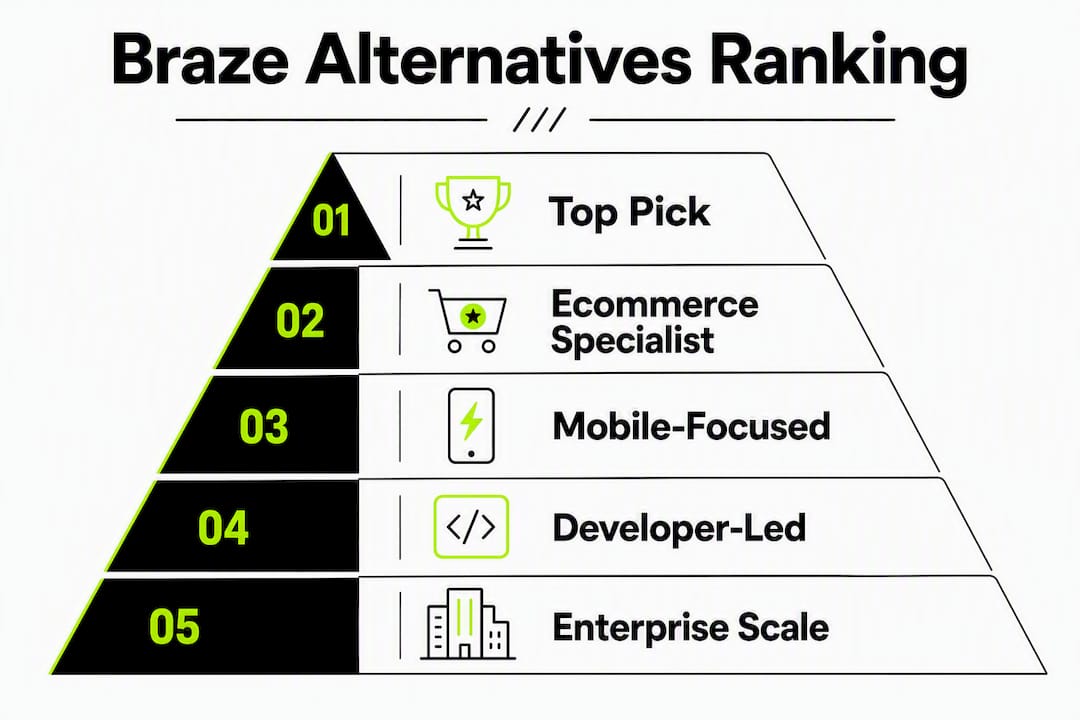
If you need a faster, more cost-effective alternative to Braze for ecommerce push and cart recovery, Storepush is the specialist pick. For SMB ecommerce email and SMS, Klaviyo leads. For enterprise cross-channel orchestration, Iterable or Insider are the strongest contenders. For developer-first teams, Customer.io is the go-to.
Here's the quick shortlist:
- Storepush — push/cart recovery (ecommerce specialist)
- Klaviyo — SMB ecommerce email/SMS
- Iterable — enterprise cross-channel orchestration
- MoEngage — mobile-first engagement
- Customer.io — developer-first messaging
- CleverTap — high-volume mobile analytics
- Insider — AI-driven enterprise personalization
- Bloomreach — enterprise ecommerce personalization
- Salesforce Marketing Cloud — CRM-integrated enterprise suite
- Omnisend — budget-friendly SMB ecommerce
- ActiveCampaign — SMB marketing automation
- HubSpot — unified CRM plus marketing
The urgency is real: enterprise-grade platforms can surpass high annual costs as audience size and message volume scale, and that cost trajectory is the most common trigger for teams to start evaluating alternatives.
Pro Tip: Before you read the full profiles, identify your primary channel (push, email, SMS, or in-app) and your technical maturity (marketer-led vs. developer-led). Those two filters will cut this list from twelve to two or three in under a minute.
Table of Contents
- How do the top Braze alternatives compare side by side?
- Why are teams looking for Braze alternatives?
- How should you evaluate Braze alternatives?
- Which platform is the best fit for your team?
- Which alternative should you choose for your situation?
- How does customer support compare across these platforms?
- What should you expect when migrating away from Braze?
- How well do these platforms integrate with your existing tech stack?
- What security and compliance features do enterprise buyers need?
- Key Takeaways
- Storepush recovers the shoppers your email list can't reach
How do the top Braze alternatives compare side by side?
| Platform | Best For | Channels | Pricing Model | Ease of Use | Ecommerce Integrations | Scalability | Personalization / AI |
|---|---|---|---|---|---|---|---|
| Storepush | Ecommerce cart/browse recovery | Push (iOS App Clips) | Freemium + commission | Marketer-first | Shopify, WooCommerce, BigCommerce | SMB to mid-market | Revenue attribution dashboard |
| Iterable | Enterprise cross-channel orchestration | Email, SMS, push, in-app, web | Quote-based | Balanced | Moderate | Enterprise | Visual journey AI |
| Klaviyo | SMB ecommerce email/SMS | Email, SMS, push | Freemium / tiered | Marketer-first | Shopify-native, WooCommerce | SMB to mid-market | Predictive analytics |
| MoEngage | Mobile-first mid-market apps | Email, SMS, push, in-app, web | Quote-based | Balanced | Mid-market to enterprise | Strong | Send-time optimization AI |
| Bloomreach | Enterprise ecommerce personalization | Email, SMS, push, web, in-app | Quote-based | Developer-leaning | Deep ecommerce catalog | Enterprise | Product discovery AI |
| Customer.io | Developer-led API-first messaging | Email, SMS, push, in-app, web | Tiered | Developer-first | API-driven | Mid-market to enterprise | Event-driven logic |
| CleverTap | High-volume mobile analytics | Email, SMS, push, in-app, web | Quote-based | Balanced | Enterprise | Strong | Segmentation AI |
| Insider | AI-driven enterprise B2C | Email, SMS, push, in-app, web, WhatsApp | Quote-based | Balanced | Moderate | Enterprise | Autonomous AI personalization |
| Salesforce Marketing Cloud | CRM-integrated enterprise | Email, SMS, push, in-app, web | Quote-based | Developer-leaning | Deep CRM | Enterprise | Einstein AI |
| Omnisend | Budget SMB ecommerce | Email, SMS, push | Freemium / tiered | Marketer-first | Shopify, WooCommerce, BigCommerce | SMB | Template-based automation |
| ActiveCampaign | SMB marketing automation | Email, SMS, push | Tiered | Marketer-first | Shopify, WooCommerce | SMB to mid-market | Predictive sending |
| HubSpot | Unified CRM + marketing | Email, SMS, push, in-app, web | Freemium / tiered | Marketer-first | Shopify, WooCommerce | SMB to enterprise | AI content and scoring |
Why are teams looking for Braze alternatives?
Braze is a genuinely capable customer engagement platform. But capability and fit are different things, and marketers consistently cite three friction points when they start shopping for alternatives:
Pricing opacity and TCO creep. Braze does not publish list pricing. Contracts are negotiated, volume-based, and can escalate sharply as your audience grows. Teams that start at a manageable spend often find themselves locked into a much larger commitment within 18 months, with limited ability to predict costs quarter over quarter.
Implementation complexity and engineering dependency. Braze's custom Liquid logic and complex API integrations can lock teams into developer-dependent workflows, creating technical debt that makes even small campaign changes expensive. Marketing teams that expected to move fast find themselves queuing up engineering tickets for tasks that should take an afternoon.
Gaps in native ecommerce features. Braze was built for mobile app engagement, not ecommerce conversion. Cart abandonment flows, product recommendations, and browse recovery typically require additional tooling or custom builds. For ecommerce teams, that means more integrations to maintain and more places for data to break.
Fragmentation fatigue. When a platform requires a separate CDP, a separate product recommendation engine, and custom API work to handle basic ecommerce flows, the total stack cost and maintenance burden often exceeds what a more focused tool would cost outright.
The cost signal: Enterprise-grade platforms like Braze typically start with quote-based pricing and can reach high annual costs as audience size and message volume scale. That cost is the most common trigger for teams to open a vendor evaluation.
How should you evaluate Braze alternatives?
The biggest mistake teams make during vendor evaluation is treating feature parity as the goal. Buyers frequently overvalue feature parity and undervalue time-to-value for core channels like push and email. The platform that gets your highest-revenue channel live in two weeks beats the platform with a longer feature list that takes four months to implement.
The evaluation criteria that actually matter
- Channels supported: Does the platform natively cover your top one or two revenue channels, or does it require third-party connectors?
- Data model: Is it event-driven (real-time behavioral triggers) or batch-based? For cart recovery and browse abandonment, real-time event ingestion is non-negotiable.
- Ecommerce integrations: Native Shopify, WooCommerce, or BigCommerce connectors reduce setup time and eliminate data mapping errors. Check whether cart and browse abandonment flows are prebuilt or require custom development.
- Personalization and AI: Send-time optimization, predictive segments, and product recommendations vary widely in quality. Ask for a live demo with your own data, not a canned walkthrough.
- Pricing model and TCO drivers: Freemium and tiered plans give you cost predictability. Quote-based enterprise pricing can be competitive at scale but requires careful contract negotiation. Ask specifically about overage fees, message volume caps, and what triggers a tier upgrade.
- Security and compliance: SOC 2 Type II, GDPR, CCPA, and HIPAA readiness matter for enterprise procurement. Confirm certifications before shortlisting.
- Analytics and attribution: Revenue attribution (not just opens and clicks) is the metric that justifies platform spend. Platforms with built-in revenue attribution remove a frequent post-migration measurement gap.
- Support tiers: Dedicated CSM, onboarding packages, and professional services costs vary enormously. A platform with a lower license fee but high professional services dependency can cost more in year one than a pricier self-serve tool.
Questions to ask in a vendor demo
- What is your data ingestion latency for behavioral events, and what are the event volume limits at our tier?
- How long does it take to build and launch a cart abandonment flow from scratch, starting today?
- What is the recommended onboarding timeline, and what engineering resources does it require on our side?
- What are your support tiers, and what does dedicated support cost beyond the base license?
- How do you handle data portability if we decide to migrate away?
Red flags to watch for
- Pricing that requires a sales call before any numbers are shared
- Onboarding timelines measured in months, not weeks
- Professional services quoted as a percentage of annual contract value
- No native revenue attribution, only click-through or open-rate reporting
- Engineering resources required for every campaign change
Prioritized evaluation steps
- Define your top one or two revenue channels and confirm the vendor supports them natively.
- Run a quick proof-of-concept: export a representative campaign from Braze (events, segments, templates) and rebuild it in the target platform within 30 days.
- Test data portability: confirm you can export your full audience and event history before signing.
- Run a sample campaign with real traffic and measure revenue attribution, not just engagement metrics.
Pro Tip: Ask every vendor for a sandbox environment before signing. Any platform that won't let you test a live cart abandonment flow with real events before committing is a platform that knows its onboarding is painful.
Which platform is the best fit for your team?
The profiles below cover each platform's real strengths, trade-offs, and migration considerations for teams moving from Braze. Market competitors are commonly segmented by use case: enterprise personalization, SMB ecommerce email/SMS, high-volume cross-channel orchestration, and mobile-first engagement. That segmentation shapes every recommendation here.
Storepush
Storepush is the specialist pick for ecommerce teams whose primary problem is cart and browse abandonment recovery. It operates differently from every other platform on this list: instead of requiring an email address or phone number to re-engage a shopper, Storepush uses native iOS App Clips to deliver push notifications directly to a shopper's lock screen, reaching the 90%+ of visitors who leave without providing any contact information.

Best for: Ecommerce stores on Shopify, WooCommerce, or BigCommerce that want fast time-to-value on cart recovery without building a full cross-channel stack.
Standout features:
- Push recovery without email or phone number capture
- Native iOS App Clips integration
- Dashboard analytics with revenue attribution, funnel tracking, and CTR heatmaps
- Event-based triggers for cart and browse abandonment
- Direct integrations with Shopify, WooCommerce, and BigCommerce
Pricing model: Freemium entry with paid tiers; paid plans include a monthly subscription plus a commission on attributed recovered revenue.
Pros: Fast onboarding, no engineering dependency for core flows, built-in revenue attribution, reaches anonymous visitors.
Cons: Push-channel specialist (not a full cross-channel CEP), iOS-focused, not designed for enterprise omnichannel orchestration.
Migration from Braze: Storepush is additive rather than a full replacement. Teams moving away from Braze's push capabilities can run Storepush in parallel with their email or SMS platform, eliminating the need to rebuild complex cross-channel journeys while still recovering abandoned carts immediately.
For a deeper look at how cart and browse abandonment recovery differs from traditional checkout-focused approaches, the Storepush blog covers the mechanics in detail.
Iterable
Iterable is the strongest full-CEP alternative for enterprise teams that need visual journey orchestration across email, SMS, push, in-app, and web. Its flexible data model handles complex event schemas without requiring a separate CDP, and its drag-and-drop workflow builder is genuinely marketer-accessible despite the platform's enterprise depth.
Best for: Enterprise cross-channel orchestration where marketing and engineering share ownership of campaigns.
Pricing model: Quote-based. Expect enterprise-tier contracts.
Pros: Flexible data model, strong visual workflow builder, broad channel coverage.
Cons: Quote-based pricing with limited transparency, onboarding requires engineering involvement, less native ecommerce depth than Klaviyo.
Migration from Braze: Data model mapping is the main challenge. Braze's custom attributes and event properties need to be remapped to Iterable's user profile structure. Plan for a four-to-eight-week data migration phase before campaigns go live.
Klaviyo
SMB ecommerce teams consistently prefer platforms with Shopify-first integrations and prebuilt ecommerce flows, and Klaviyo is the clearest example of why. Its Shopify connector is the deepest in the market: product browse, cart abandonment, post-purchase, and win-back flows are prebuilt and launch in hours, not weeks. Predictive analytics (including predicted lifetime value and churn risk) are available on paid tiers without additional tooling.
Best for: SMB and mid-market ecommerce brands on Shopify or WooCommerce.
Pricing model: Freemium up to 250 contacts; tiered pricing scales with list size.
Pros: Shopify-native flows, marketer-friendly segmentation, transparent tiered pricing, strong email and SMS in one platform.
Cons: Costs can scale quickly as list size grows, limited in-app messaging, not designed for enterprise omnichannel complexity.
Migration from Braze: Klaviyo's import tools handle contact and event history well. The main gap is in-app messaging: teams that relied on Braze's in-app channel will need a separate solution or accept that channel gap.
MoEngage
MoEngage targets mobile-first businesses at the mid-market level, with a strong emphasis on behavioral analytics and AI-driven send-time optimization. Its Sherpa AI engine analyzes user behavior to determine the best time and channel for each message, which meaningfully improves engagement rates for high-frequency apps.
Best for: Mid-market mobile apps and consumer brands with a large mobile user base.
Pricing model: Quote-based.
Pros: Deep mobile analytics, send-time optimization, solid push and in-app capabilities.

Cons: Less ecommerce-native than Klaviyo, quote-based pricing, web personalization is less mature than mobile.
Migration from Braze: SDK swap is the primary technical task. MoEngage's mobile SDKs cover iOS and Android, but teams with heavily customized Braze SDK implementations should budget two to four weeks for QA.
Bloomreach
Bloomreach combines a customer data platform, email/SMS/push orchestration, and product discovery into a single suite. For enterprise ecommerce brands that need unified personalization across the full shopping journey (search, browse, recommendations, and post-purchase messaging), it removes the need for separate CDP and product recommendation tooling.
Best for: Enterprise ecommerce brands that need product discovery and customer engagement in one platform.
Pricing model: Quote-based.
Pros: Unified product and customer data, deep ecommerce personalization, strong product discovery AI.
Cons: High implementation complexity, enterprise-only pricing, significant professional services investment typically required.
Migration from Braze: Bloomreach's CDP layer handles data ingestion from Braze exports, but rebuilding journeys in its visual editor takes time. Expect a three-to-six-month full migration timeline for complex implementations.
Customer.io
Customer.io is the platform of choice for developer-led teams that want API-first flexibility without Braze's pricing complexity. Its event-driven architecture means any behavioral event can trigger a message in any channel, and its API documentation is among the clearest in the market. SMB-focused platforms commonly offer freemium or transparent tiered pricing, and Customer.io's tiered model gives developer teams cost predictability that Braze's quote-based contracts rarely provide.
Best for: Developer-led SaaS and consumer app teams that want full control over event logic.
Pricing model: Tiered, based on message volume.
Pros: Excellent API documentation, event-driven flexibility, transparent pricing, strong multi-channel support.
Cons: Less marketer-friendly UI than Klaviyo or HubSpot, limited native ecommerce flows, requires engineering for complex journeys.
Migration from Braze: Customer.io's event schema is flexible enough to mirror Braze's custom events with minimal remapping. The main adjustment is rebuilding Canvas-style journeys in Customer.io's campaign builder, which uses a different visual paradigm.
CleverTap
CleverTap is built for high-volume mobile apps that need granular behavioral analytics alongside engagement. Its segmentation engine can handle millions of users with real-time cohort analysis, making it a strong fit for consumer apps with complex user lifecycle stages.
Best for: High-volume mobile apps (gaming, fintech, media) that need deep analytics and engagement in one platform.
Pricing model: Quote-based.
Pros: Deep mobile analytics, powerful segmentation, strong push and in-app capabilities.
Cons: Web channel is secondary, ecommerce-specific flows are less prebuilt, enterprise pricing.
Migration from Braze: Similar to MoEngage, the primary migration task is SDK replacement and event schema mapping. CleverTap's onboarding team typically handles data migration for enterprise contracts.
Insider
Insider positions itself as an AI-first personalization platform spanning web, mobile, email, SMS, push, and WhatsApp. Its Sirius AI layer can autonomously test and optimize journeys, which appeals to enterprise B2C teams that want to reduce manual campaign management. WhatsApp support is a genuine differentiator for brands with international audiences.
Best for: Enterprise B2C brands that want AI-driven journey optimization and WhatsApp coverage.
Pricing model: Quote-based.
Pros: Autonomous AI personalization, WhatsApp channel, broad channel coverage.
Cons: Enterprise-only pricing, complex onboarding, less transparent than SMB-focused alternatives.
Migration from Braze: Insider's implementation team handles data migration as part of onboarding, but the process is typically tied to a professional services engagement. Budget accordingly.
Salesforce Marketing Cloud
Salesforce Marketing Cloud makes the most sense when your organization is already deep in the Salesforce ecosystem. Einstein AI, Journey Builder, and native CRM data sync are genuinely powerful when the underlying CRM data is clean and well-structured. Outside that context, the platform's complexity and cost are hard to justify.
Best for: Enterprises with Salesforce CRM as their system of record.
Pricing model: Quote-based, typically among the highest TCO on this list.
Pros: Deep CRM integration, Einstein AI, broad enterprise feature set.
Cons: Very high TCO, steep learning curve, significant professional services dependency.
Migration from Braze: The most complex migration on this list. Salesforce's data model is CRM-centric, not event-driven, so Braze's behavioral event history requires significant transformation work.
Omnisend
Omnisend is the fastest-to-launch option for SMB ecommerce teams that need email, SMS, and push in one place without a large budget. Its prebuilt automation templates (cart abandonment, welcome series, order confirmation) cover the core ecommerce flows out of the box, and its freemium tier is genuinely usable for early-stage stores.
Best for: Early-stage and budget-conscious ecommerce brands on Shopify, WooCommerce, or BigCommerce.
Pricing model: Freemium; paid tiers scale with contact count.
Pros: Fast onboarding, prebuilt ecommerce templates, freemium entry, all three major ecommerce platforms supported.
Cons: Limited personalization depth, less AI capability than MoEngage or Insider, not designed for enterprise scale.
ActiveCampaign
ActiveCampaign's strength is workflow automation breadth at a predictable price. Its template library covers both B2C and B2B use cases, and its CRM-lite functionality means SMBs can manage contacts and campaigns in one tool without a separate CRM subscription.
Best for: SMBs running marketing automation across B2C and B2B with a need for cost predictability.
Pricing model: Tiered, with transparent published pricing.
Pros: Broad workflow templates, transparent pricing, built-in CRM-lite, strong email deliverability.
Cons: Push and in-app channels are less mature, less ecommerce-native than Klaviyo, UI can feel dated.
HubSpot
HubSpot's freemium CRM entry point makes it the default starting platform for many SMBs, and its marketing hub integrates email, SMS, push, and landing pages with the same contact database used by sales and support. The trade-off is depth: HubSpot's marketing automation is broad but rarely the deepest option in any single channel.
Best for: Teams that want a single platform for CRM, marketing automation, and basic multi-channel campaigns.
Pricing model: Freemium CRM; marketing hub tiers scale with contact count and features.
Pros: Unified CRM and marketing, marketer-friendly UI, strong integration ecosystem, freemium entry.
Cons: Marketing automation depth lags behind Iterable or Braze at enterprise scale, costs escalate quickly at higher tiers.
Pro Tip: If you're evaluating HubSpot as a Braze replacement, run a side-by-side comparison of your top three highest-revenue journeys in both platforms before committing. HubSpot's journey builder handles linear flows well but can struggle with complex branching logic that Braze handles natively.
How these alternatives were selected
The platforms on this list were evaluated using a structured process:
- Hands-on flow testing: Core ecommerce flows (cart abandonment, browse recovery, post-purchase) were tested where sandbox access was available.
- Feature matrix: Each platform was mapped against the comparison dimensions in the table above: channels, pricing model, ease of use, ecommerce integrations, scalability, and AI capabilities.
- Review aggregation: G2 and Gartner Peer Insights ratings and reviewer commentary were used to validate real-world strengths and weaknesses.
- Vendor documentation: Pricing pages, API docs, and integration guides were reviewed for transparency and completeness.
- Pricing signals: Where public pricing was available, it was used directly. Where pricing is quote-based, the descriptor reflects that reality.
Pricing figures in this article reflect publicly available information and practitioner reports. Enterprise contracts vary significantly; always request a formal quote and ask specifically about overage fees and professional services costs before signing.
This article is published by Storepush, a push-first cart recovery platform for ecommerce. The methodology was designed to give fair treatment to all alternatives while being transparent about Storepush's own positioning as a specialist tool rather than a full CEP replacement.
Which alternative should you choose for your situation?
The right platform depends on your company size, technical maturity, and primary revenue channel. Here's how to map your profile to the best option:
- Mid-market ecommerce (growing catalog, need for personalization): — Bloomreach or MoEngage, depending on whether your primary channel is web/email or mobile. Both require a larger implementation investment but deliver deeper personalization at scale.
Pro Tip: Run a 30-day pilot before committing to any platform migration. Export a representative Braze campaign, including events, segments, and templates, and rebuild it in your target platform. If the rebuild takes more than two weeks of engineering time, that's a signal the platform's complexity will slow your team down long-term.
How does customer support compare across these platforms?
Support quality is one of the most underweighted factors in platform selection, and it tends to matter most in the first 90 days after launch.
Enterprise platforms like Salesforce Marketing Cloud, Braze, Insider, and Bloomreach typically bundle dedicated customer success managers (CSMs) into their contracts, but those CSMs are often shared across multiple accounts. Response times for technical issues can vary, and complex problems frequently escalate to professional services engagements that carry additional cost.
Mid-market platforms like MoEngage, CleverTap, and Iterable offer tiered support: standard email and chat support on base tiers, with dedicated CSMs available at higher contract values. Iterable is generally regarded by practitioners as having strong onboarding support for enterprise customers.
SMB-focused platforms tell a different story. Klaviyo, Omnisend, and ActiveCampaign rely heavily on self-serve documentation, community forums, and chat support. That model works well for teams with marketing-led implementations but can frustrate teams that need hands-on technical guidance. HubSpot's support is broad but can feel generic for complex marketing automation questions.
Customer.io stands out for developer-first support: its documentation is detailed, its API reference is well-maintained, and its community Slack is active. For developer-led teams, that often matters more than a dedicated CSM.
Storepush is built for fast self-serve onboarding, with direct integrations for Shopify, WooCommerce, and BigCommerce that minimize the need for support contact in the first place. For ecommerce teams that want to launch cart recovery without a lengthy onboarding engagement, that simplicity is the support model.
What should you expect when migrating away from Braze?
Switching from Braze is rarely a weekend project. The platform's flexibility is also its migration complexity: custom Liquid templates, complex event schemas, and SDK integrations all require careful mapping before you can go live on a new platform.
Data migration is the first challenge. Braze stores user profiles with custom attributes and event histories that don't map cleanly to every alternative's data model. Iterable and Customer.io handle flexible event schemas well. Salesforce Marketing Cloud and HubSpot require more transformation work because their data models are CRM-centric rather than event-driven.
SDK replacement affects any team using Braze's mobile push or in-app capabilities. Swapping SDKs requires a new app release, which means a delay between migration start and full channel parity. Plan for this in your timeline, especially if your app release cycle is monthly or quarterly.
Journey rebuilding is where most teams underestimate the effort. Braze's Canvas builder supports complex multi-step, multi-channel journeys with conditional logic. Rebuilding those in a new platform's visual editor takes time, and the logic doesn't always translate directly. A useful approach: prioritize your top five highest-revenue journeys for the initial migration and run everything else in parallel until you've validated parity.
Attribution continuity is a frequently overlooked risk. If your current Braze reporting is tied to custom conversion events, you'll need to rebuild that attribution logic in the new platform. Platforms with built-in revenue attribution (Storepush, Klaviyo, Bloomreach) reduce this risk; platforms that rely on UTM parameters and third-party analytics require more setup.
Teams frequently underestimate ongoing engineering costs after initial implementation; custom logic and API dependencies create technical debt that makes seemingly small changes expensive. That pattern repeats on the destination platform if you choose one with similar complexity. The cleaner migration path is often to a more focused tool that handles your highest-revenue channel natively.
How well do these platforms integrate with your existing tech stack?
Beyond ecommerce connectors, the platforms on this list vary significantly in how well they integrate with CRM, analytics, data warehouse, and CDP tools that most marketing teams already have in place.
CRM integration is the clearest differentiator. Salesforce Marketing Cloud and HubSpot are built around CRM data as the source of truth. Iterable and Customer.io treat CRM as one data source among many, pulling in contact and account data via API or native connectors. MoEngage and CleverTap are primarily behavioral platforms; CRM integration is available but secondary to their mobile analytics core.
Analytics and data warehouse connectivity matters for teams running Snowflake, BigQuery, or Redshift as their data layer. Iterable, Customer.io, and Bloomreach all support reverse ETL patterns, allowing warehouse-computed segments to flow directly into campaign targeting. Klaviyo's data model is more self-contained, which simplifies setup but limits flexibility for teams with complex data architectures.
CDP compatibility is relevant for teams that have already invested in a standalone CDP like Segment or mParticle. Customer.io, Iterable, and Bloomreach all have native Segment integrations. Klaviyo and Omnisend are more self-contained and work best when their own data layer is the primary source of truth.
Analytics platform integration (Google Analytics 4, Amplitude, Mixpanel) varies by platform. Most support UTM parameter passing and webhook-based event forwarding, but native two-way integrations (where campaign data flows back into your analytics platform for attribution modeling) are less common. Bloomreach and Iterable handle this more gracefully than SMB-focused platforms.
Storepush integrates directly with Shopify, WooCommerce, and BigCommerce at the storefront level, with its own revenue attribution dashboard handling the measurement layer. For teams whose primary analytics need is "how much revenue did this push notification recover," that self-contained model removes a common integration complexity.
What security and compliance features do enterprise buyers need?
For enterprise procurement, security and compliance are gate criteria, not differentiators. Every platform on this shortlist should be able to provide documentation for the following before you advance them to a final evaluation:
SOC 2 Type II is the baseline certification for SaaS platforms handling customer data. Braze, Iterable, Klaviyo, Customer.io, MoEngage, CleverTap, Insider, Salesforce Marketing Cloud, Bloomreach, ActiveCampaign, and HubSpot all hold SOC 2 Type II certifications. Confirm the current audit period and request the report directly.
GDPR and CCPA compliance affects any platform that processes data from EU or California residents. All major platforms on this list support data subject access requests (DSARs), right-to-deletion workflows, and consent management. The implementation burden, however, varies: some platforms require custom configuration to honor consent flags correctly, while others handle it natively.
HIPAA readiness is relevant for health and wellness brands. Salesforce Marketing Cloud, HubSpot, and Customer.io offer Business Associate Agreements (BAAs). Confirm availability and scope before assuming coverage.
Data residency matters for enterprise customers with regulatory requirements around where data is stored. Salesforce Marketing Cloud, Bloomreach, and Iterable offer regional data residency options. SMB-focused platforms like Klaviyo and Omnisend are primarily US-hosted; confirm data residency options if your compliance requirements specify EU or other regional storage.
Role-based access control (RBAC) and SSO are standard enterprise requirements. Iterable, Salesforce Marketing Cloud, Bloomreach, and Customer.io all support RBAC and SAML-based SSO. SMB platforms vary: HubSpot and ActiveCampaign support SSO on higher tiers; Omnisend's enterprise SSO support is more limited.
For ecommerce teams using Storepush, the platform processes behavioral event data (cart and browse actions) without requiring PII like email addresses or phone numbers, which reduces the compliance surface area compared to full-CEP platforms that store and process complete customer profiles.
Key Takeaways
The best Braze alternative is the one that gets your highest-revenue channel live fastest, at a predictable cost, without requiring engineering resources for every campaign change.
| Point | Details |
|---|---|
| Match platform to technical maturity | Developer-led teams fit Customer.io or Iterable; marketing-led teams fit Klaviyo, Omnisend, or Storepush. |
| Enterprise total cost of ownership can grow substantially with audience size | Quote-based platforms scale costs with audience size; always model overage fees and professional services before signing. |
| Time-to-value beats feature parity | The platform that launches your top revenue channel quickly outperforms a richer platform that takes longer to implement. |
| Migration requires a 30-day pilot | Export a real Braze campaign and rebuild it in your target platform to validate parity before committing to a full migration. |
| Storepush for cart/browse recovery | Storepush recovers anonymous visitors via iOS App Clips push without requiring email or phone, with built-in revenue attribution. |
The real lesson from platform selection
Most teams that struggle with Braze don't have a Braze problem. They have a scope problem. They bought a platform capable of orchestrating 12 channels across millions of users, and then spent six months trying to get a cart abandonment email to fire reliably.
The pattern repeats with every enterprise CEP: the platform's power is real, but so is the overhead. Custom Liquid templates, SDK dependencies, and API-driven segmentation are genuinely useful when you have the engineering bandwidth to maintain them. When you don't, they become the reason your marketing team can't ship a campaign without filing a ticket.
The most pragmatic advice for any team in a Braze evaluation is to start with the channel that moves revenue fastest, get it live in under 30 days, and measure actual recovered revenue before expanding. That discipline filters out platforms that look impressive in a demo but slow you down in production. It also surfaces the cases where a specialist tool (a push-first recovery platform, a Shopify-native email tool) outperforms a full CEP on the metric that actually matters to your business.
Feature breadth is not a competitive advantage if your team can't use it.
Storepush recovers the shoppers your email list can't reach
Every platform on this list assumes you have a way to contact the shopper. Email requires an opt-in. SMS requires a phone number. Most cart recovery tools are built for the 10% of visitors who identify themselves.
Storepush is built for the other 90%. Using native iOS App Clips, it delivers push notifications directly to a shopper's lock screen without requiring an email address, phone number, or app installation. For Shopify, WooCommerce, and BigCommerce stores, setup takes hours, not months, and the revenue attribution dashboard shows exactly which push notifications drove purchases.
If you're evaluating full CEPs like Iterable or Klaviyo for your ecommerce stack, Storepush works alongside them as a specialist recovery layer, not a replacement. It fills the gap those platforms can't: anonymous visitor recovery at the moment of abandonment.
Book a demo to see how Storepush fits your store's recovery workflow, or visit storepush.io to explore the platform.
Further reading and sources
- Top Braze Customer Engagement Platform Alternatives & Competitors 2026 | Gartner Peer Insights — Peer-reviewed ratings and buyer commentary from enterprise practitioners evaluating Braze and its alternatives.
- Best Braze Competitors and Alternatives in 2026 | Bloomreach — Detailed vendor comparison with use-case segmentation; useful for understanding how enterprise ecommerce buyers evaluate the market.
- 11 Best Braze Alternatives in 2026 | Email Vendor Selection — Independent editorial review with pricing signals and hands-on commentary on implementation complexity.
- Top 10 Braze Alternatives & Competitors | G2 — Aggregated user reviews across MoEngage, Klaviyo, Iterable, Customer.io, and CleverTap; useful for real-world strength and weakness validation.
- Cart Abandonment Is a Browsing Problem, Not a Checkout Problem | Storepush — Storepush's analysis of where cart recovery tools typically fall short and how push-first approaches address the gap.