
The most reliable cookieless retargeting ecommerce stack right now combines four approaches: first-party audience activation (CRM/hashed email uploads), server-side tracking with Conversion APIs, engagement-based platform audiences, and privacy-first push or email/SMS re-engagement. Together, they recover the reach that third-party cookies used to deliver, without the compliance exposure.
Here's how those four approaches rank by impact versus implementation effort:
- First-party list activation (hashed CRM uploads to Meta, Google, TikTok): highest impact, lowest engineering lift, start here
- Server-side tracking + Conversion APIs: high impact, moderate engineering effort, the backbone of a durable stack
- Engagement-based platform audiences (video views, page engagement, on-platform signals): solid reach, zero engineering, best as a complement
- Privacy-first push notifications (App Clip + lock-screen push via StorePush): high intent, no email or phone required, fastest path to recovering anonymous cart abandoners
Your fastest 48-hour win: Export your last 90 days of purchasers and cart abandoners, hash the emails, and upload them as suppression and retargeting lists to Meta and Google. That single step costs nothing and immediately improves audience quality.
Key Takeaways
First-party audience activation combined with server-side Conversion APIs is the highest-impact, most durable foundation for cookieless retargeting in ecommerce, delivering match rate recoveries to roughly 70–80% on platforms that accept hashed PII.
| Point | Details |
|---|---|
| Start with first-party lists | Hash and upload CRM segments to Meta, Google, and TikTok this week for immediate audience quality gains. |
| Server-side events are the backbone | Conversion APIs recover match rates to roughly 70–80% and bypass ad blockers that degrade pixel audiences. |
| Run holdout tests to validate ROAS | Assign 10–20% of your retargeting audience to a holdout group and measure incremental lift before scaling spend. |
| Compliance is operational, not optional | CMP consent signals must flow to your server-side container, and all PII must be SHA-256 hashed before upload. |
| StorePush reaches anonymous abandoners | App Clip push recovery re-engages visitors who never provided an email or phone number, with no app install required. |
Table of Contents
- How did cookie-based retargeting actually work?
- Why are third-party cookies disappearing, and where does that leave you?
- What is cookieless retargeting, and which models should you use?
- What do you gain, and what do you give up?
- Practical cookieless tactics to recover abandoned carts
- Step-by-step checklist to set up cookieless retargeting
- How do you measure performance without third-party cookies?
- US privacy compliance for cookieless retargeting
- Common mistakes that will waste your budget and expose your data
- How App Clip + lock-screen push recovers carts without emails or phone numbers
- Two sample abandoned-cart sequences you can test this week
- An honest take on what to prioritize when your team is stretched
- StorePush recovers carts from the visitors no other channel can reach
- Sources
How did cookie-based retargeting actually work?
Classic retargeting ran on a simple but fragile chain. You placed a JavaScript pixel on your store. When a shopper visited a product page or added something to their cart, that pixel fired and dropped a third-party cookie in their browser. Ad platforms like Meta and Google read that cookie when the shopper later visited other sites, matched them back to your pixel audience, and served your ad.
Picture a shopper who adds a pair of running shoes to their cart, then walks away. The pixel fires, the cookie is set, and within hours that shopper sees your shoe ad on a news site, a recipe blog, and their social feed. The whole system worked because browsers freely shared cookie data across domains.
The problem is that the chain had weak links from the start. Ad blockers stripped pixels before they could fire. Safari's Intelligent Tracking Prevention (ITP) began capping third-party cookie lifetimes at 24 hours as far back as 2017. Firefox followed with Enhanced Tracking Protection. Industry analysis confirms that these browser privacy controls left pixel audiences missing a significant share of actual visitors, with some practitioners reporting gaps of 30–60%. The cookie-based model was always leakier than the dashboards suggested.
Why are third-party cookies disappearing, and where does that leave you?
The deprecation story has three threads: browser defaults, mobile OS changes, and Google's Privacy Sandbox.
Safari and Firefox blocked third-party cookies by default years ago, covering a combined share of US browser usage that no ecommerce marketer can ignore. Apple's App Tracking Transparency (ATT), introduced with iOS 14.5 in 2021, required explicit opt-in for cross-app tracking, which collapsed the signal quality of mobile ad platforms almost overnight.
Google took longer. Chrome held off on a hard deprecation date while the Privacy Sandbox matured, and as of 2026, Chrome still processes third-party cookies for most users, though Google has shifted toward a user-choice model rather than a blanket block. The direction is clear even if the final switch hasn't flipped.
The Protected Audience API is Google's answer to remarketing in a post-cookie world. It stores interest groups directly in the browser and runs ad auctions on the device, so no cross-site identifier ever leaves the user's machine. That's the key distinction: the remarketing logic moves on-device rather than relying on a shared cookie visible to third parties.
What this means for your planning: Don't wait for Chrome's final deprecation date to act. Safari and Firefox already cover enough of your traffic that a cookieless strategy is a present-day revenue problem, not a future one.
What is cookieless retargeting, and which models should you use?
Cookieless retargeting, sometimes called privacy-first retargeting, means re-engaging shoppers who visited your store using signals that don't depend on third-party cookies. The Usercentrics guide frames it as building audiences from consented first-party signals, with consent management platform (CMP) alignment as the operational foundation.
The core models available to ecommerce teams today:
- First-party hashed identifiers (CRM/Customer Match): You hash customer emails and phone numbers before uploading to ad platforms. High accuracy on matched users, CCPA-friendly when consent is captured, but reach is limited to known customers. J2B Marketing's guidance recommends scrubbing, hashing, segmenting by behavior, and refreshing lists regularly to maintain match quality.
- Server-side tracking + Conversion APIs: Events fire from your server rather than the browser, bypassing ad blockers and ITP entirely. Moderate engineering effort, but D2C Times reports that full Conversion API stacks recover match rates to around three-quarters on platforms that accept hashed PII.
- Engagement-based platform audiences: Users who watched your video ads, engaged with your Instagram posts, or visited your TikTok profile can be retargeted entirely within the platform. Zero engineering, zero cross-site tracking, but reach is confined to users already on that platform.
- Contextual and publisher audience targeting: Ads appear alongside relevant content rather than following a specific user. No identifier needed, but you lose the behavioral signal that made retargeting precise.
- IP-to-device and CRM-to-device workflows: OnSpot documents deterministic workflows where website visitor IPs are matched to device IDs, with match rates often in the 40–80% range depending on data quality. Useful for reaching anonymous visitors who never gave you an email.
- Protected Audience API (Privacy Sandbox): Developer documentation details how interest groups are added via
navigator.joinAdInterestGroup(), auctions run vianavigator.runAdAuction(), and interest group data persists up to 30 days. On-device worklets isolate auction code so no cross-site data leaks. Still early-stage adoption, best treated as a complement. - Lock-screen push via App Clips: Captures opt-in consent during a native App Clip experience, then delivers push notifications directly to the lock screen, no email or phone number required. High intent, works on anonymous visitors.
What do you gain, and what do you give up?
Going cookieless isn't a straight upgrade. It's a trade.
What you gain:
- Cleaner consent hygiene, which reduces legal exposure under CCPA/CPRA
- Higher match quality on the audiences you do reach, because consented first-party data is more accurate than probabilistic cookie matching
- Ad-blocker resistance when you move to server-side event collection
- Cross-device continuity through server-side identity resolution, which cookies never reliably delivered on mobile
What you accept:
| Tradeoff | What it means in practice |
|---|---|
| Reach shrinkage | Anonymous visitors you can't identify via email or phone are harder to retarget without IP/device workflows or push opt-ins |
| Aggregate reporting | Event-level user data is increasingly replaced by modeled or aggregated signals, making per-user attribution harder |
| Engineering investment | Server-side tagging and Conversion API setup requires developer time, not just a pixel paste |
| Vendor dependency | Deterministic device matching relies on third-party data providers whose match rates vary |
The practical answer is a hybrid stack. First-party activation handles your known customers. Server-side events and Conversion APIs recover the anonymous-but-identifiable segment. Engagement-based platform audiences fill the gap for users who never gave you data. Contextual buys cover the rest. Privacy Sandbox experiments sit on the roadmap as a long-term complement, not a near-term fix. Singlegrain's analysis confirms that contextual and Privacy Sandbox pilots are showing early conversion lifts for adopters, though first-party strategies remain the primary driver.
Practical cookieless tactics to recover abandoned carts
First-party list activation
Your capture points are checkout (email at step one), account creation, loyalty program enrollment, and progressive profiling (asking for preferences post-purchase). Hash emails with SHA-256 before any upload. Upload to Meta's Custom Audiences, Google Customer Match, and TikTok's Custom Audiences. Expect match rates of 40–60% on a healthy list; below 30% signals a data hygiene problem worth fixing before scaling spend.
Segment your lists before uploading. Cart abandoners from the last 7 days deserve different creative and urgency than 90-day lapsed purchasers. Refreshing lists weekly keeps match rates from decaying.
Server-side audience building
Move your event collection off the browser. Server-side Google Tag Manager (GTM) or a dedicated event endpoint sends ViewContent, AddToCart, InitiateCheckout, and Purchase events directly from your server to platform APIs. This bypasses ITP and ad blockers, and it lets you deduplicate events (send both browser and server events with a shared event_id so platforms don't double-count). Your event schema for cart abandoners should capture at minimum: event_name, event_time, user_data (hashed email/phone where available), custom_data (product IDs, value, currency), and event_source_url.
Pro Tip: Set up event deduplication from day one. Sending both browser and server events without a shared event_id inflates your reported conversions and corrupts your audience signals. Platforms like Meta use the event_id field specifically for this — don't skip it.
Engagement-based platform audiences
On Meta, build audiences from video viewers (25%, 50%, 75% thresholds), Instagram profile visitors, and lead form openers. On TikTok, use video engagers and profile visitors. On Google, use YouTube viewers and engaged website visitors via Google Signals. These audiences require no cross-site data and no engineering work. They're particularly useful for top-of-funnel retargeting where you're warming up visitors who aren't yet in your CRM.
Push and device-based recovery
This is where you recover the anonymous majority. Most ecommerce stores see 90%+ of visitors leave without purchasing, and a large share of those never provide an email. Lock-screen push via App Clips captures opt-in consent during the browsing session and delivers push notifications directly to the shopper's device. No email, no phone number, no app install required. For browse abandonment and cart recovery, this channel reaches the segment that every other method misses.
Contextual and publisher audience complements
For users you genuinely can't identify, contextual targeting places ads alongside relevant content categories. A shopper who browsed running shoes gets served your ad on running-focused editorial content. Frequency cap contextual campaigns tightly (3–5 impressions per user per week) since you can't suppress converters the way you can with first-party lists.
Step-by-step checklist to set up cookieless retargeting
- Audit your consent management platform (CMP). Confirm your CMP fires before any tracking tags and that consent signals flow to your server-side container. Without this, your first-party data is legally exposed under CCPA/CPRA.
- Deploy server-side tagging. Set up a server-side GTM container (or equivalent) on a first-party subdomain (e.g.,
metrics.yourstore.com). Route browser events through it to preserve cookie lifetimes and bypass ad blockers. - Define a unified event schema. Standardize event names and parameters across all platforms. At minimum:
ViewContent,AddToCart,InitiateCheckout,Purchase, each withevent_id,event_time,user_data(hashed), andcustom_data(product IDs, value). - Build your CDP or CRM audience segments. Segment by recency (7-day cart abandoners, 30-day browsers, 90-day lapsed), value (AOV tiers), and behavior (product category). Export as hashed lists.
- Sync audiences to platforms. Upload hashed lists to Meta Custom Audiences, Google Customer Match, and TikTok Custom Audiences. Schedule weekly refreshes.
- Activate Conversion APIs. Connect Meta CAPI, Google Enhanced Conversions, and TikTok Events API to your server-side container. Validate with each platform's event testing tool before going live.
- Set creative sequencing and frequency caps. Map ad creative to funnel stage (awareness, consideration, recovery). Cap frequency at 7–10 impressions per user per week for retargeting audiences; lower for contextual.
- Build suppression lists. Upload recent purchasers (last 30 days) as suppression audiences on every platform. Nothing erodes trust faster than retargeting someone who already bought.
- QA and validate. Use Meta's Events Manager, Google's Tag Assistant, and TikTok's Events testing tool to confirm event firing, deduplication, and match rates. Target a match rate above 40% before scaling spend.
- Pilot the Protected Audience API. If your engineering team has capacity, implement
navigator.joinAdInterestGroup()for cart abandoners on Chrome. Interest groups persist up to 30 days per the developer documentation, giving you a cookieless remarketing signal within Chrome's privacy model.
Pro Tip: Don't skip the suppression list step. Running retargeting ads to users who purchased in the last 30 days wastes budget and annoys your best customers. Build the suppression audience before you launch any paid retargeting.
How do you measure performance without third-party cookies?
Attribution in a cookieless world is less precise but more honest. Here's what you can trust and what you should triangulate.
Measurement approaches:
- Platform-reported event-level data: Still available for consented users and server-side events. Reliable for directional performance but increasingly incomplete as a full picture.
- Aggregated reporting APIs: Meta's Aggregated Event Measurement and Google's Privacy Sandbox Reporting APIs return aggregated conversion counts with added noise to protect individual privacy. Useful for budget decisions, not for per-user analysis.
- Server-side attribution: Match server-logged events (purchases, cart adds) against your own first-party user IDs. The most accurate signal you own, independent of platform reporting.
- Modeled attribution: Platforms fill gaps in observed data with statistical models. Treat modeled numbers as directional, not precise.
Running an incrementality test:
- Define your test audience (a retargeting segment with at least 10,000 users for statistical power).
- Randomly assign 10–20% to a holdout group that sees no retargeting ads.
- Run for 2–4 weeks, long enough to capture your typical purchase cycle.
- Compare conversion rates between exposed and holdout groups. The difference is your incremental lift.
- Calculate incremental ROAS: (incremental revenue from exposed group) divided by (ad spend on exposed group).
D2C Times recommends pairing incrementality tests with server-side attribution to avoid over-claiming on platform-reported numbers. The metrics worth trusting first: incremental recovered revenue, conversion lift percentage, and ROAS adjusted for audience overlap.
Reporting cadence: Review platform event match rates weekly. Review incremental ROAS monthly. Run a full holdout test quarterly to recalibrate your spend allocation.
US privacy compliance for cookieless retargeting
CCPA and CPRA apply to most ecommerce businesses operating in California, and their practical reach extends to any US store with a meaningful California customer base. Here's what your compliance checklist should cover:
- Consent notice: Display a clear, plain-language notice before collecting any behavioral data. Your CMP must capture and log consent with a timestamp.
- Opt-out mechanism: Provide a "Do Not Sell or Share My Personal Information" link in your footer. This applies to sharing hashed data with ad platforms for audience matching.
- Data minimization: Collect only what you need for retargeting. Don't store raw behavioral logs indefinitely.
- Retention windows: Set a maximum retention period for retargeting data (90–180 days is a common standard). Delete or anonymize beyond that window.
- Vendor DPAs: Every platform and data partner that receives your customer data must sign a Data Processing Agreement. Ask specifically about hashing practices, anonymization methods, breach response timelines, and data deletion processes.
- Hashing before upload: Never upload raw emails or phone numbers to ad platforms. SHA-256 hash all PII before it leaves your environment.
Pro Tip: Align your consent capture with your audience activation. If a user opts out of data sharing, your CMP should automatically suppress them from server-side event pipelines and flag them for removal from uploaded lists at the next refresh cycle. Manual suppression processes break down at scale.
When evaluating a retargeting vendor, ask these questions directly: What match methodology do you use, and can you show match rate documentation? Do you operate within a Trusted Execution Environment (TEE) or use a proxy for data matching? What is your breach response SLA? How do you handle deletion requests under CCPA? If a vendor can't answer these clearly, that's your answer.
Common mistakes that will waste your budget and expose your data
The biggest mistake teams make is treating cookieless retargeting as a single tactic rather than a layered system. Swapping your pixel for a Conversion API and calling it done leaves most of your retargeting surface uncovered.
Watch for these specific pitfalls:
- Underinvesting in first-party capture. If you're not collecting email at checkout step one, you're shrinking your retargetable audience before the campaign even starts. Progressive profiling and loyalty programs are the cheapest audience-building tools you have.
- Skipping incrementality testing. Platform-reported ROAS on retargeting campaigns is almost always overstated because it counts users who would have converted anyway. Without a holdout test, you're paying for credit, not causation.
- Over-segmenting lists. Splitting your audience into 15 micro-segments sounds precise but produces lists too small to exit the learning phase on most platforms. Start with 3–5 behavioral segments and consolidate if match rates fall below 1,000 users.
- Ignoring frequency capping. Without third-party cookies to track cross-site exposure, frequency management falls entirely on your platform settings. Uncapped retargeting burns budget and trains your best prospects to ignore your ads.
- Ignoring suppression. Retargeting recent purchasers is a fast way to generate negative sentiment. Build suppression lists before you build retargeting audiences.
Vendor red flags to watch for:
- Opaque match rates with no documentation or third-party validation
- No DPA or vague language about hashing and anonymization
- Claims of deterministic cross-site tracking without a clear technical explanation of how it avoids third-party cookie dependency
- Uplift claims that aren't backed by holdout test methodology
How App Clip + lock-screen push recovers carts without emails or phone numbers
Most cookieless retargeting tactics require at least a hashed email to work. App Clip push recovery doesn't.
Here's how the flow works technically. A shopper visits your store on their iPhone. An App Clip card loads natively, presenting a lightweight version of your store experience. The shopper taps to engage, and iOS prompts them to allow notifications. That single tap captures push consent without requiring an email address, a phone number, or an app download. The consent is tied to the device at the OS level.
From there, the recovery sequence runs on timing and behavioral triggers:
- Visit → App Clip opt-in: Consent captured, device token registered
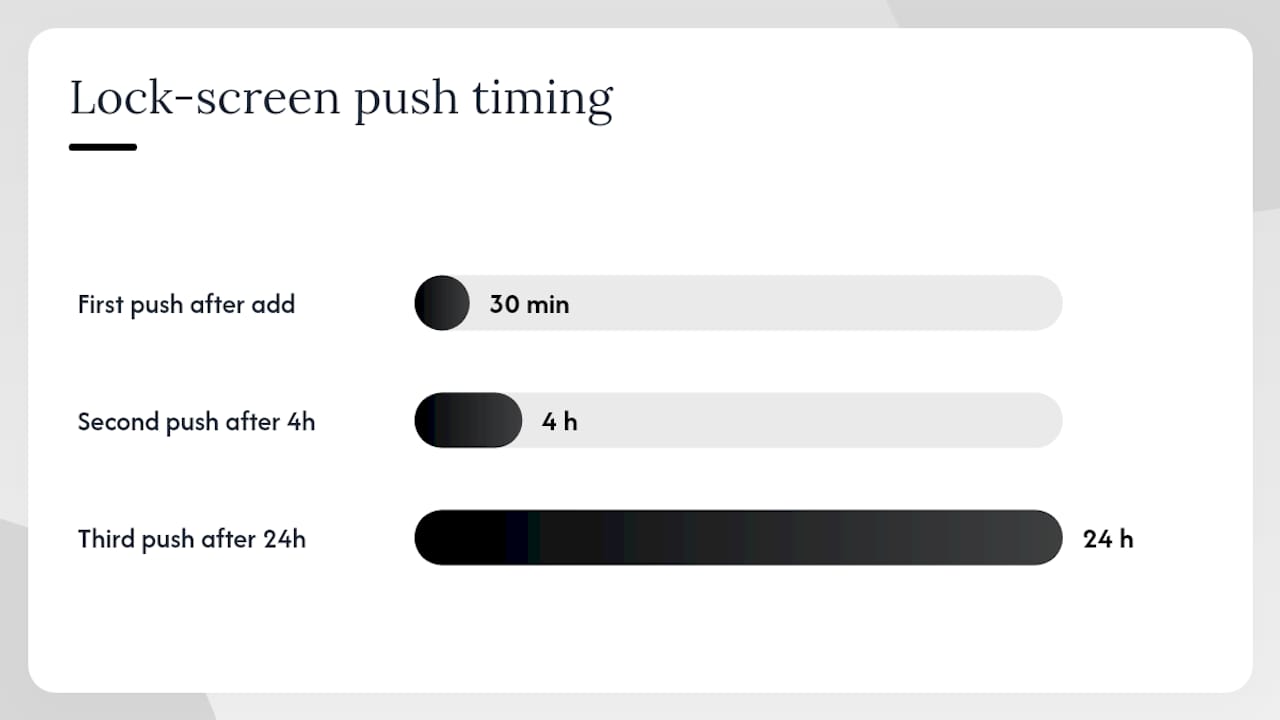
- Cart add → no purchase within 30 minutes: First push fires to lock screen ("Your cart is waiting")
- No conversion within 4 hours: Second push fires with product imagery and urgency signal
- No conversion within 24 hours: Third push fires, optionally with a discount or free shipping offer
- Purchase: Suppress from push sequence immediately, log attributed revenue
Attribution works by matching the push click event (timestamped, device-level) against your server-side purchase log. You can run a small holdout test by suppressing push for 10–15% of opt-in users and comparing purchase rates against the exposed group. That delta is your incremental recovery rate.
Push notifications sent to the lock screen via App Clips reach shoppers at the moment their phone is in their hand, without competing with a crowded email inbox or a buried Gmail tab. For anonymous visitors who never gave you contact information, this is often the only re-engagement channel available.
For a deeper look at the mechanics of recovering abandoned carts without PII, the technical flow and attribution approach are covered in detail.
Two sample abandoned-cart sequences you can test this week
Email + SMS flow (for identified visitors)
| Timing | Channel | Message intent | Suppression rule |
|---|---|---|---|
| — | Browse reminder, no discount | Suppress if purchased | |
| 6 hours | SMS | Cart reminder, product name + image | Suppress if purchased or email opened |
| 48 hours | Discount or free shipping offer | Suppress if purchased or SMS clicked |
Keep SMS messages under 160 characters. Lead with the product name, not your brand name. "Your [Product] is still in your cart. Grab it before it sells out." outperforms generic "Don't forget your cart!" messages in most tests.
For SMS targeting compliance and segmentation, confirm opt-in status before every send and honor opt-outs within the same session.
Push-first flow (for anonymous and identified visitors)
- 30 minutes post-cart-add, no purchase: Push 1, lock screen, product image + "Still thinking it over?"
- 4 hours, no conversion: Push 2, lock screen, urgency signal ("Only 3 left in stock" if inventory data is available)
- 24 hours, no conversion: Push 3, optional discount, final nudge
- Escalation rule: If the user has a known email and hasn't converted after Push 3, escalate to email sequence above
- Frequency cap: Maximum 3 pushes per cart abandonment event, 7-day cooldown before next push sequence
The push-first flow works for both anonymous visitors (push only) and identified visitors (push first, then email/SMS escalation if unconverted). Frequency caps are non-negotiable here. Three pushes per event is the ceiling; beyond that, opt-out rates climb sharply.
Timing rule for both flows: The first touch within 60 minutes of abandonment consistently outperforms later sends. Cart intent decays fast. If your first message arrives 24 hours later, you're competing with a shopper who has already found an alternative.
An honest take on what to prioritize when your team is stretched
The biggest mistake busy ecommerce teams make isn't choosing the wrong cookieless tactic. It's trying to build the full stack at once and shipping nothing.
Here's a realistic three-step prioritization:
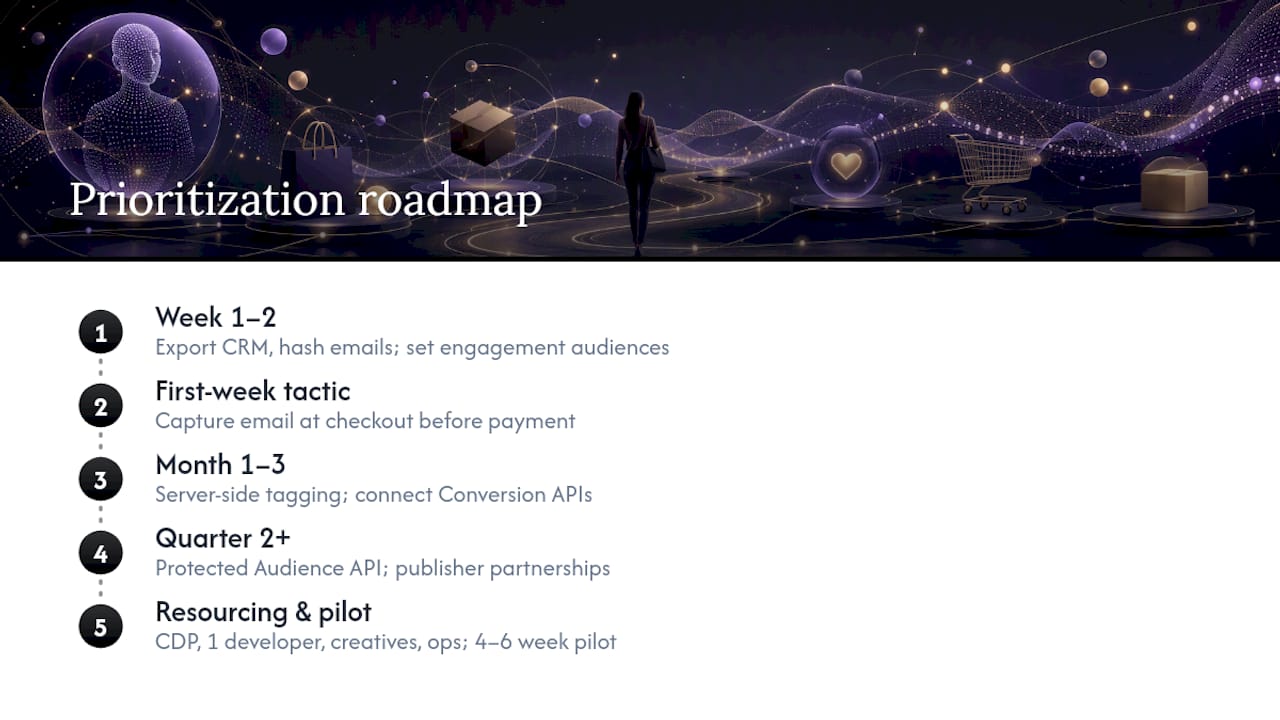
Week 1–2 (quick wins, no engineering required): Export your CRM, hash your emails, and upload retargeting and suppression lists to Meta and Google. Set up engagement-based audiences on every platform where you run ads. These two steps cost zero engineering time and immediately improve audience quality.
Month 1–3 (medium effort, high payoff): Deploy server-side tagging and connect Conversion APIs to Meta, Google, and TikTok. This is where you need a developer for a week or two, but the match rate recovery justifies it. Pair this with a proper CMP audit to make sure consent signals flow correctly to your server-side container.
Quarter 2 and beyond (long lead, strategic): Experiment with the Protected Audience API for Chrome-based remarketing. Build publisher audience partnerships for contextual reach. These take longer to show results and require more coordination, but they're the foundation of a durable cookieless stack.
For the first week, one tactical item to start: audit your checkout flow and confirm you're capturing email at step one, before payment. If you're not, you're losing the most valuable retargeting signal at the exact moment intent is highest. Reducing cart abandonment starts with capturing the signal before the shopper walks away.
Resourcing this realistically means involving your CDP or data team for list management, one developer for server-side setup, your creative team for sequenced ad assets, and your ops team for suppression list maintenance. A 4–6 week pilot scoped to one product category or one audience segment is enough to validate the approach before committing to a full rollout.
StorePush recovers carts from the visitors no other channel can reach
Every cookieless tactic covered here has one shared limitation: it requires some form of identification, whether a hashed email, a platform account, or a prior ad engagement. StorePush is built for the gap those tactics leave open.
By using native iOS App Clips, StorePush captures push consent directly on the device during the shopping session, no email address, no phone number, no app install. That means you can re-engage the majority of visitors who leave your store without ever identifying themselves. The lock-screen push arrives at the moment the shopper's phone is in their hand, not buried in an inbox.
StorePush integrates with Shopify, WooCommerce, BigCommerce, and custom storefronts. The dashboard tracks recovered revenue, CTR heatmaps, funnel drop-off, and event-based triggers, so you can see exactly which push sequences are pulling carts back. Implementation is lightweight, and the first recovered purchase typically arrives within days of going live.
If you're running a cookieless retargeting stack and still leaving anonymous cart abandoners unaddressed, book a StorePush demo to see how lock-screen push fits into your recovery flow.
Sources
- Protected Audience (developers) — Google Privacy Sandbox
- Retargeting Strategies for the Privacy Era | Audiencelab
- Cookieless Audience Targeting: Retargeting Strategies | OnSpot
- How to Build a Retargeting Stack That Converts in a Cookieless World – D2C Times
- How to Build Cookieless Retargeting Strategies That Work | Singlegrain
- Privacy-first retargeting using first-party CRM data | J2B Marketing
- Guide To Audience Re-Engagement Using Cookieless ... | Usercentrics