
Incrementality testing measures what your marketing actually caused, isolating the sales, sign-ups, or revenue that would not have happened without a specific campaign. If you run ecommerce marketing and want a fast start, do this in the next 72 hours: pick your largest-spend campaign, carve out a 10% randomized holdout or matched geo-control group, and pre-register a single primary KPI before you look at results.
Here's your rollout order:
- Pick the campaign with the biggest media budget, since that's where a bad allocation decision costs you the most.
- Set the holdout at 10% (user-level) or select 3 to 5 matched control geos, and lock the split before launch.
- Pre-register your KPI (incremental revenue, checkout rate, whatever matters most) so you're not tempted to cherry-pick metrics after the fact.
Expect a trade-off: you'll sacrifice some short-term revenue by deliberately not marketing to your holdout group. That's the price of knowing whether your spend is working or just riding on sales that would have happened anyway.
Key Takeaways
Incrementality testing works because it isolates causal lift through randomized holdouts or matched geo-controls, correcting the inflated ROAS that platform attribution routinely reports.
| Point | Details |
|---|---|
| Start with your biggest campaign | Run a 10% holdout or 3 to 5 matched geo-controls on your largest-spend channel first. |
| Platform ROAS overstates impact | A reported 4.0x ROAS can translate to a real iROAS near 1.3x once you isolate true incremental revenue. |
| Match test type to the question | Use geo-lift for offline/cross-device effects, user-level holdouts for CRM and retargeting. |
| Feed results into MMM and attribution | Apply correction factors to platform numbers before they inform budget decisions. |
| Track CLV, not just day-one lift | Incremental customers with weak retention overstate a channel's true value. |
| Recover sessions before you test | StorePush's push-based cart recovery via iOS App Clips shrinks the unexplained organic baseline and complements an experiment-first measurement program. |
Table of Contents
- What Incrementality Testing Measures, and Why It Beats Attribution Alone
- Why Platform ROAS and Native Attribution Often Mislead You
- Which Incrementality Test Type Fits Your Situation?
- How Do You Design a Valid Incrementality Test?
- How Do You Calculate Lift and Incremental ROAS (iROAS)?
- How Do You Turn Test Results into Budget Decisions?
- What Pitfalls Cause Incrementality Tests to Fail?
- Which Tools Handle Incrementality Testing for Ecommerce?
- How Do You Test Incrementality for Cart Recovery and Push Notifications?
- What Do Real Ecommerce Incrementality Tests Look Like?
- How Do You Isolate Incrementality Across Multiple Marketing Channels?
- How Does Incrementality Testing Connect to Customer Lifetime Value?
- Building a Repeatable Incrementality Practice
- An Adjacent Lever: Recovering Revenue Before You Even Test It
- Frequently Asked Questions
- Sources
What Incrementality Testing Measures, and Why It Beats Attribution Alone
Incremental lift is the difference between what happened with your marketing treatment and what would have happened without it. That's a causal question, not a correlation question, and it's why attribution is not the same thing as incrementality: attribution maps which touchpoints a customer crossed before buying, but it can't tell you whether the campaign caused the sale or just happened to be nearby.
Three methods answer three different questions:
- Attribution models answer "which touchpoints appeared in the path to purchase?" A last-click model, for instance, might hand full credit to a branded search ad that only fired because the customer already decided to buy after seeing a Meta ad three days earlier.
- Marketing mix modeling (MMM) answers "how does spend across channels correlate with revenue over months or quarters?" It's built for portfolio-level budget allocation, not for validating a single campaign's causal effect.
- Incrementality testing answers "would this specific outcome have happened without this specific marketing?" It's the only one of the three built to isolate cause and effect.
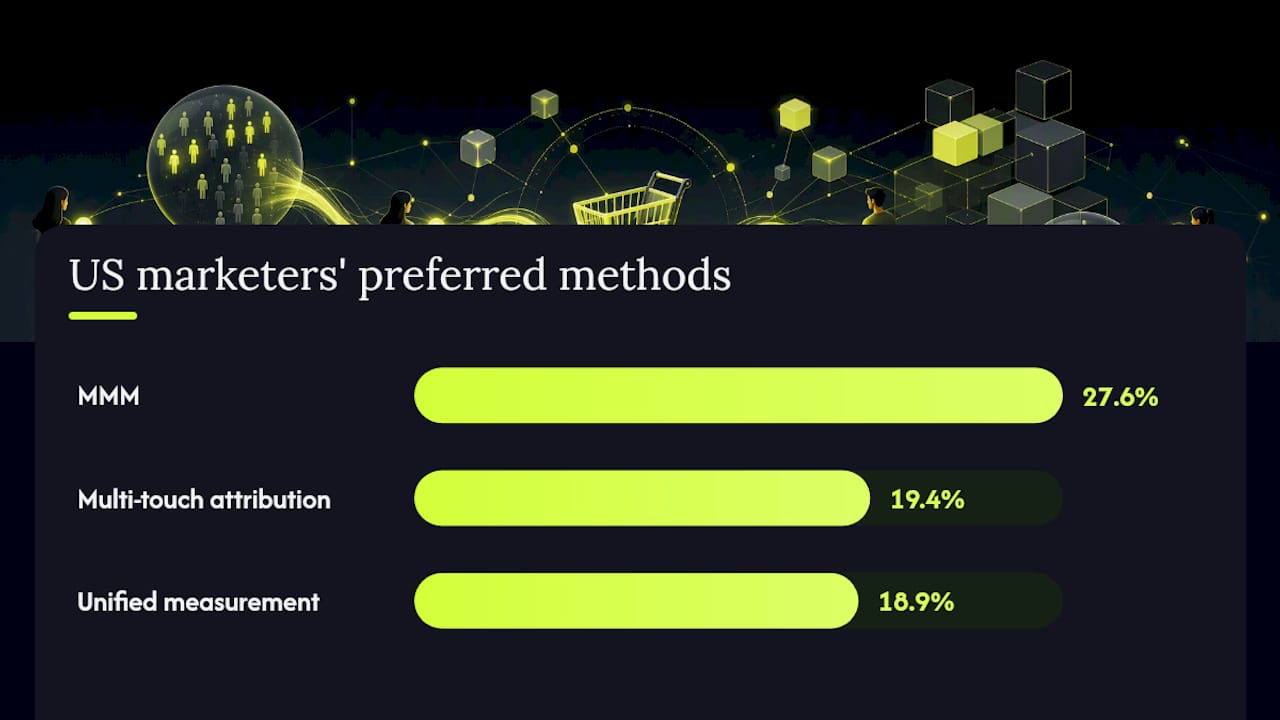
A recent industry survey found 27.6% of US marketers consider MMM the most reliable measurement method, ahead of multi-touch attribution at 19.4% and unified measurement at 18.9%, which tells you the field hasn't settled on one winner. That's the point: these methods complement each other rather than compete.
Pro Tip: Use MMM to decide how to split your budget across channels quarterly, attribution to optimize campaigns daily, and incrementality testing to validate that either method's conclusions hold up under a real causal test.
Why Platform ROAS and Native Attribution Often Mislead You
Platform dashboards are built to make the platform look good, not to give you an honest read on causality. Five mechanisms routinely inflate the numbers you see in Ads Manager or Google Ads:
- Last-click bias hands full credit to whichever channel closed the sale, ignoring everything upstream that actually built the demand.
- View-through ambiguity counts an impression as a "conversion" even when the customer never clicked or consciously noticed the ad.
- Double-counting happens when two platforms both claim credit for the same purchase, since neither sees the other's touchpoints.
- Cross-channel cannibalization shows up when a paid search ad "converts" a shopper who was already headed to your site through organic search.
- Delayed conversions get misattributed to whichever campaign happens to be running when the sale finally posts, even if it ran weeks earlier.
Here's what that looks like in practice: a platform reports a 4.0x ROAS on a retargeting campaign. Multiply 4.0 by 0.33 and you get a real iROAS of roughly 1.3x, which is a very different budget conversation.
Signal loss from cookie deprecation and iOS tracking changes makes all five problems worse, since platforms increasingly fill measurement gaps with modeled estimates rather than observed data.
Pro Tip: Never take a platform's self-reported ROAS as your budget baseline. Treat it as a directional signal until an incrementality test gives you a correction factor.
Which Incrementality Test Type Fits Your Situation?
Four core test designs cover most ecommerce use cases, and picking the wrong one wastes both budget and time.
Geo-lift tests split markets into matched treatment and control regions, turning campaigns on in some and holding them off in others. This works well when you need to measure a channel's total effect, including offline or cross-device behavior that user-level tracking would miss entirely. Retail chains and DTC brands running broad awareness or video campaigns lean on geo-lift because it captures halo effects that a click-based test can't see.
Randomized user-level holdouts withhold a specific campaign from a random slice of your audience, typically at the individual or household level. This is the go-to method for CRM, retargeting, and lifecycle flows, where you can cleanly assign a holdout at the moment someone enters a segment.
Platform conversion-lift studies, like Google Ads Conversion Lift, run inside the ad platform itself using either user-based or geography-based methods, and they can operate without cookies by incorporating first-party data and trimmed-match regression techniques. These give directional, campaign-level insight fast, but you're trusting the platform's own randomization.
Synthetic control groups build a statistical stand-in for "what would have happened" using historical data patterns rather than a live control group, useful when you can't ethically or practically withhold marketing from any real segment.
Match the method to the constraint that matters most:
- Need to capture offline or cross-device impact? Use geo-lift.
- Need tight control over randomization? Use user-level holdouts.
- Need fast, campaign-specific direction with minimal setup? Use platform lift.
- Can't build a real control group? Use synthetic controls.
- Worried about contamination between test and control? Geo-lift and user-level holdouts both handle this better than platform lift, which depends on the platform's internal exposure logic.
How Do You Design a Valid Incrementality Test?
A test that skips steps produces a number you can't trust, and a wrong budget decision costs more than the test itself. Work through this checklist in order:
- Define the question precisely. "Does retargeting drive incremental revenue?" is testable. "Is retargeting good?" is not.
- Choose your primary KPI and minimum detectable effect (MDE) before launch, whether that's incremental revenue, checkout rate, or incremental conversions per dollar.
- Pick your randomization unit. User-level for CRM and retargeting flows, geo-level for broad channels like paid social or video.
- Set your holdout size. For user-level tests, 10% to 20% is the standard range. For geo-lift, 3 to 5 matched control geos is typical, balanced against the audience or region size you have available.
- Match your control group on historical revenue, seasonality pattern, and audience composition, not just population size.
- Configure suppressions so control-group members don't accidentally see the treatment through another channel.
- Lock creative and budgets for the test duration. Changing either mid-test invalidates the comparison.
- Set run duration before launch, not after you see early results.
- Pre-register your analysis plan, including which statistical test you'll run and what threshold counts as significant.
On duration: most reliable incrementality reads take 4 to 8 weeks, and that window should stretch closer to 8 weeks for higher-AOV products with longer consideration cycles. A $30 impulse buy needs less run time than a $400 purchase someone researches for two weeks.
There's a real trade-off between holdout size and test duration. A bigger holdout gets you statistical power faster but sacrifices more short-term revenue. A smaller holdout protects revenue but forces you to run longer to hit the same power. If your traffic volume is thin, lean toward extending duration rather than cutting the holdout below 10%, since an underpowered test that ends early just produces noise dressed up as an answer.
Pro Tip: Run a sample ratio mismatch (SRM) check within the first few days. If your treatment and control groups aren't splitting close to your intended ratio, something's broken in your randomization, and every result downstream is suspect.
Avoid running two incrementality tests on overlapping audiences at the same time. Overlap muddies which campaign actually caused whatever lift you measure, and you'll spend weeks arguing about it after the fact.
How Do You Calculate Lift and Incremental ROAS (iROAS)?
The math isn't complicated, but skipping steps is how teams end up trusting a number they shouldn't.
Incremental conversion rate = conversion rate (treatment group) minus conversion rate (control group).
Incremental revenue per user = average revenue per user (treatment) minus average revenue per user (control).
Total incremental revenue = incremental revenue per user multiplied by the total treatment group size.
Incremental ROAS (iROAS) = total incremental revenue divided by media spend.
Here's the worked example from earlier, laid out step by step. Incremental revenue = $200,000 × 0.33 = $66,000.
Before you act on any result, run through this checklist:
- P-value: is it below your pre-set threshold (commonly 0.05, sometimes 0.10 for smaller tests)?
- Confidence interval: does the range around your lift estimate exclude zero?
- MDE: was your test actually powered to detect an effect of the size you found?
- Practical significance: even if statistically significant, is the lift large enough to justify the spend?
Decision rules from here are straightforward. If lift is significant and positive, scale the budget and schedule a re-test after any major creative or platform change. If lift is not significant, extend the test or increase your sample before concluding the channel doesn't work. If lift is significant and negative, that's your cue to pause or restructure the campaign, not just shrug it off as noise.
How Do You Turn Test Results into Budget Decisions?
A test that sits in a slide deck is wasted effort. The value shows up when you feed results back into the systems you use to allocate spend every week.
Build this into your process:
- Generate correction factors from each incrementality test (like the 0.33x factor from the retargeting example) and apply them to that channel's platform-reported numbers going forward.
- Feed corrected figures into attribution dashboards so daily optimization decisions reflect reality, not platform-inflated ROAS.
- Let MMM handle portfolio-level allocation across channels, using your incrementality-corrected data as one of its inputs rather than raw platform numbers.
- Re-test quarterly, or immediately after a major platform change like an ad-ranking algorithm update or a new iOS privacy release.
- Maintain a sentinel holdout. Once you've proven a channel's incrementality, shrink the holdout to 3% to 5% and keep it running indefinitely to catch drift before it costs you real budget.
Apply that factor to the channel's monthly reported revenue before it goes into your budget model, then track downstream customer lifetime value (CLV) for the cohort acquired during the test window. If CLV holds up over the following two quarters, that's confirmation your correction factor reflects genuine incremental customers, not a short-term blip in your sentinel holdout.
What Pitfalls Cause Incrementality Tests to Fail?
Most failed tests trace back to one of six repeat offenders:
- Sample size too small: extend the test duration rather than declaring a result on underpowered data.
- Overlapped promotions: a sitewide sale mid-test contaminates both groups equally. Reschedule around planned promotions.
- Audience spillover: control-group members see the treatment anyway through another channel. Switch to geo-level testing when spillover risk is high.
- Short test windows: a two-week test on a 30-day purchase cycle product will underestimate lift. Match duration to at least 1.5x your typical purchase cycle.
- Changing creative mid-test: this invalidates the comparison entirely. Lock assets before launch.
- Peeking early: stopping the moment results look favorable inflates false positives. Commit to your pre-registered end date.
Incrementality testing also has real limits. It doesn't scale cleanly to thousands of micro-experiments running simultaneously without dedicated automation and infrastructure, and a lift result from one season, region, or audience segment doesn't always extrapolate cleanly to another. Treat each test as evidence for its specific context, not a universal law.
Which Tools Handle Incrementality Testing for Ecommerce?
You don't need to build everything from scratch, and most teams shouldn't. A handful of tool categories cover the ecommerce use case:
- Platform-native lift tools, like Google Ads Conversion Lift, work well for fast, campaign-specific reads inside a single channel.
- Third-party experiment platforms such as Haus and Measured specialize in geo-lift and cross-channel incrementality, useful when you need results independent of any single ad platform's internal logic.
- Analytics and data platforms like Amplitude and Triple Whale help track the downstream conversion and revenue data your tests depend on, even if they're not incrementality engines themselves.
- MMM and growth-consulting providers, including agencies like Common Thread Collective, help translate test results into portfolio-level budget models.
- Analytics libraries supporting CUPED and other variance-reduction techniques boost statistical power without forcing a bigger holdout.
In-house testing makes sense once you have enough order volume to hit statistical power within a reasonable window and an analyst who can own the math. Below that threshold, a vendor with built-in experiment design saves you from running underpowered tests that waste budget without producing a usable answer.
Pro Tip: Keep a test registry, a running log of every experiment, its dates, and its result, so you're not accidentally re-running the same question you already answered six months ago.
How Do You Test Incrementality for Cart Recovery and Push Notifications?
Lifecycle channels like cart-recovery push and email need their own holdout discipline, since randomizing at the wrong point corrupts the whole test. Here's the sequence:
- Randomize at flow entry, not at message send. If you randomize later, you've already let selection bias creep in.
- Hold out 10% to 20% of eligible users, consistent with industry best practices for triggered flows.
- Suppress alternate channels for holdout users, so they don't get the same message through email or SMS instead.
- Run for 2 to 4 weeks, or roughly 1.5x your typical purchase cycle, whichever is longer.
Track incremental checkout rate, incremental revenue per recipient (iRPR), any AOV shift in the treatment group, and downstream return or retention rates.
Pro Tip: Validate sample ratio mismatch before trusting any lift number, and use deterministic hashing for assignment with delivered messages as your denominator, not sent, since sent-but-undelivered notifications will quietly deflate your measured lift. Once you've proven the flow works, drop to a sentinel holdout and keep monitoring rather than re-running the full test every month.

What Do Real Ecommerce Incrementality Tests Look Like?
The pattern across successful ecommerce incrementality programs tends to follow the same arc: a team suspects a channel is overreporting its impact, runs a structured holdout, and finds the platform-reported number was inflated by a meaningful margin.
Retail brands running geo-lift tests on broad awareness campaigns have found that a channel with mediocre last-click attribution numbers sometimes shows strong geo-level lift once offline and cross-device effects get captured, the opposite failure mode from the retargeting example above. That's the core lesson from every credible case study in this space: incrementality doesn't just correct overclaimed channels, it also surfaces underclaimed ones that attribution was quietly ignoring.
The actionable pattern that repeats across brands: treat the first test as a baseline, not a verdict, then build a re-test cadence around it so the correction factor stays current as your channel mix, creative, and audience evolve.
How Do You Isolate Incrementality Across Multiple Marketing Channels?
Single-channel tests get harder to interpret as your channel mix grows, since a lift in one channel might just be cannibalizing demand from another rather than creating anything new. A few advanced techniques handle this.
Portfolio-level holdouts withhold an entire cluster of channels, not just one, from a control group, letting you measure the combined incremental effect of your paid marketing stack rather than one channel in isolation. This catches the cannibalization problem that single-channel tests miss entirely, where a lifecycle campaign can appear to lift its own metrics while quietly pulling demand from another channel, leaving net-new demand flat even as the individual channel's numbers look great.
Factorial and staggered rollout designs stagger which channels turn on and off across different geos or time windows, letting you isolate each channel's marginal contribution even when several run simultaneously. This is more complex to set up than a simple holdout, but it's the only reliable way to answer "what does channel B add on top of channel A?" rather than treating each channel's lift as if it existed in a vacuum.
Synthetic control triangulation combines a statistical synthetic control with a smaller live holdout, cross-checking one method against the other to catch cases where your synthetic model's assumptions don't hold in the real world.
Whichever technique you use, the underlying discipline stays the same: watch total portfolio conversions, not just the channel you're testing, and be suspicious of any result where one channel's lift exactly matches another's decline.
How Does Incrementality Testing Connect to Customer Lifetime Value?
A channel that drives incremental orders isn't automatically a channel worth scaling. If a promotion or acquisition channel pulls in incremental customers who churn fast or never repeat, you've bought incremental revenue at a cost your retention numbers won't support.
Tie your incrementality results to CLV by tracking the cohort acquired during each test window for at least one full purchase cycle past the test's close, ideally longer. If the treatment group's incremental customers show CLV comparable to or better than your baseline acquisition mix, that's confirmation the channel earns its corrected iROAS. If their CLV lags significantly, your headline lift number is overstating the channel's real value, since it's counting revenue from customers who won't stick around.
This matters even more for lifecycle and re-engagement channels, where the same push notification or email flow that shows strong incremental checkout rate in a two-week test might be pulling forward purchases customers would have made anyway a few weeks later, rather than creating truly new demand. Watching retention and repeat-purchase rate for the incremental cohort over 60 to 90 days helps separate genuine incremental value from purchase-timing shifts.
The practical move: build CLV tracking into your test analysis plan from the start, not as an afterthought. A test that only reports day-one incremental revenue is giving you half the picture.
Building a Repeatable Incrementality Practice
Getting one test right is easy. Getting your organization to run tests consistently, and actually act on the results, is the harder problem, and it's where most measurement programs stall.
Assign clear ownership before your first test: one person or team designs the test and owns the statistical rigor, and a separate stakeholder, usually whoever controls the budget, signs off on acting on the result.
Build incrementality testing into your planning calendar the same way you'd schedule a budget review, not as a one-off project you tackle when someone gets nervous about a channel. That means slotting re-tests before major vendor renewals or negotiations, since a corrected iROAS number is leverage in those conversations that a platform's self-reported ROAS never gives you.
Document everything: test dates, holdout size, correction factors, and CLV follow-up, in a shared registry. Schedule automatic re-tests after any major creative refresh or platform algorithm change, since a correction factor from six months ago on a different creative set isn't a number you can trust today.
An Adjacent Lever: Recovering Revenue Before You Even Test It
Here's something worth factoring into your measurement plan: the more abandoned sessions you recover before checkout, the cleaner your incrementality baseline gets. Every cart or browse abandonment you never address is a session your organic and paid channels both quietly compete to "explain," muddying whichever test you run on top of it.
StorePush recovers those sessions differently than email or SMS retargeting, which both require an email address or phone number you often don't have. That's not a replacement for the experiment-first measurement approach this guide walks through. It's a complementary tactic that shrinks the base of unexplained organic conversions your incrementality tests have to account for.
If you're running an ecommerce store on Shopify, WooCommerce, BigCommerce, or a custom storefront and want to see how push recovery fits alongside your existing measurement stack, you can book a StorePush demo to walk through your funnel data and see where the recoverable revenue is hiding.
Frequently Asked Questions
What is incrementality testing in ecommerce? Incrementality testing measures the conversions or revenue that would not have happened without a specific marketing campaign, using randomized holdouts or matched control groups to isolate that causal effect from what the platform's attribution model reports.
How is incrementality different from attribution? Attribution assigns credit to touchpoints a customer crossed before buying, without proving any of them caused the sale. Incrementality testing uses a control group to measure what actually would have happened without the marketing, answering the causation question attribution can't.
How long should an incrementality test run? Most reliable ecommerce tests run 4 to 8 weeks, with longer windows needed for higher-AOV products or longer purchase-consideration cycles.
What holdout size should I use? For geo-lift tests, 3 to 5 matched control geos typically provides enough statistical power without sacrificing too much revenue.
Can I run incrementality testing without cookies? Yes. Methods like geo-lift and Google Ads Conversion Lift's aggregated approaches work without individual-level cookie tracking, which is part of why experiment-first measurement has grown alongside privacy changes.
How does incrementality testing work with push notifications and CRM flows?
Sources
- Marketing analytics: attribution is not incrementality — Avinash Kaushik
- Use incrementality testing for effective marketing measurement — Google (Business/Think)
Recommended
- CRO for E-Commerce: Stop Optimizing Only for the 7% Who Add to Cart | StorePush
- How to Increase Conversions: 10 Strategies (and the One Most E-Commerce Brands Miss) | StorePush
- Cart Abandonment Is a Browsing Problem, Not a Checkout Problem | StorePush
- Shopify Conversion Rate Optimization: The Complete Guide (2026) | StorePush