
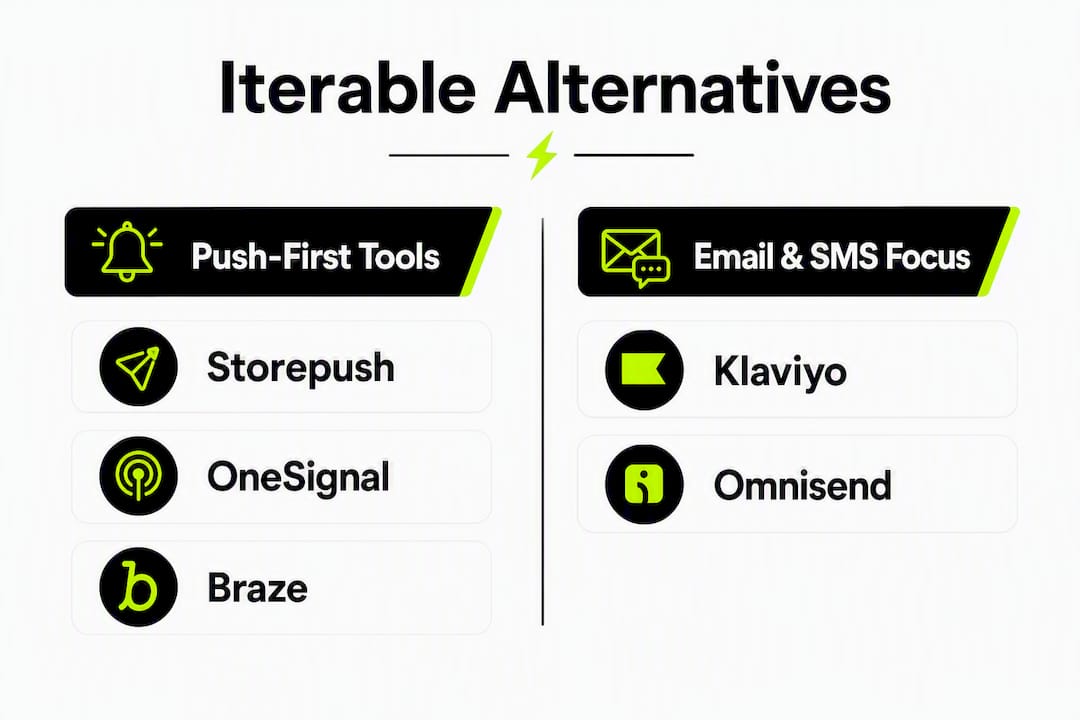
If your primary goal is recovering abandoned carts without collecting customer emails or phone numbers, Storepush is the strongest alternative to Iterable for that specific brief. Iterable is a capable enterprise customer engagement platform, but it’s built for teams with dedicated marketing ops and engineering resources — and it assumes you already have contact data to work with. If you’re running a Shopify, WooCommerce, or BigCommerce store and you need to re-engage the shoppers who walk away before giving you anything, Iterable and most of its well-known competitors aren’t designed for that job. Storepush is. Check the comparison table below to validate that quickly, then use the buying guide to confirm the fit.
Table of Contents
-
What are the best Iterable alternatives for push-first cart recovery?
-
U.S. privacy, Apple rules, and technical limits you need to know
What are the best Iterable alternatives for push-first cart recovery?
The table below covers the platforms that come up most often when store owners evaluate Iterable competitors. The “Requires email/phone?” column is the one that matters most for this brief.
| Platform | Best for | Channels | Requires email/phone? | Shopify integration | Pricing model | Technical complexity | Recovery/attribution | US availability |
|---|---|---|---|---|---|---|---|---|
| Storepush | Push-first, no-contact-data recovery | Push (iOS App Clips) | No | One-click plugin | Subscription + commission on recovered revenue | Low — no engineering needed | Dashboard: CTR, revenue attribution, funnel tracking | Yes — CCPA-aware |
| Iterable | Enterprise omnichannel campaigns | Email, SMS, push, in-app | Yes | Custom API/webhook | Custom enterprise quote | High — needs marketing ops + engineering | Advanced journey analytics | Yes |
| Klaviyo | Shopify email and SMS for mid-market | Email, SMS, push | Yes | One-click | Active-profile subscription | Low-medium | Strong email/SMS attribution | Yes |
| Omnisend | E-commerce email + SMS automation | Email, SMS, push, web push | Yes | One-click | Tiered subscription | Low | Solid e-commerce attribution | Yes |
| OneSignal | App publishers, mobile push at scale | Push, in-app, email, SMS | Yes (for re-engagement) | Plugin available | Free tier + paid plans | Low-medium | Basic push analytics | Yes |
| Braze | Mobile-first enterprise engagement | Push, email, SMS, in-app, web | Yes | Custom engineering | Custom enterprise quote | High — needs engineering | Advanced AI-driven attribution | Yes |
Reading the table: Any row marked “No” in the “Requires email/phone?” column can re-engage shoppers who never identified themselves. Only Storepush achieves this through native iOS App Clips, which reach shoppers directly on their lock screens. Every other platform on this list requires a known contact to send a follow-up message.
How do you choose between Iterable and its alternatives?
The most common reason teams leave Iterable is procurement friction and complexity — they want tools they can self-serve without a sales cycle or a dedicated engineering sprint. That’s a useful filter to start with, but for push-first cart recovery, the checklist goes further.
Must-have vs. nice-to-have
Must-haves for push-first, no-email recovery:
-
Native push capability that does not require a stored email or phone number
-
iOS App Clip or equivalent mechanism to reach anonymous shoppers
-
One-click or plugin-based Shopify integration (the engineering delta between a plugin and a custom API build is often measured in weeks, not days)
-
Transparent pricing with no mandatory sales demo to see a number
-
Revenue attribution tied to push-triggered purchases, not just clicks
Nice-to-haves (don’t let them distract you):
-
AI decisioning and predictive send-time optimization
-
Bundled CDP, loyalty, and on-site personalization
-
Omnichannel journey orchestration across six-plus channels
Prioritize a platform that treats push as a first-class channel if push-driven recovery is your primary use case. Omnichannel is often a catch-all that sounds good in a demo but delivers mediocre push performance.
Questions to ask vendors
-
Does your platform re-engage shoppers who never provided an email or phone number?
-
How does your Shopify integration work — one-click plugin or custom API?
-
Do you support native iOS App Clips, or only browser-based web push?
-
How is recovered revenue attributed — last-click, view-through, or holdout test?
-
What is your commission rate on attributed recovered revenue, and how is it calculated?
-
What does migration support look like for behavioral event streams and historical data?
Red flags to watch for
-
Pricing only available after a sales demo
-
“Push support” that turns out to be browser web push only (which doesn’t work reliably on iOS)
-
Recovery attribution that can’t be verified with a holdout group
-
Required engineering resources before you can send your first notification
-
Enterprise-grade platforms that assume you have a marketing ops team and a dedicated engineer
Why Storepush is the recommended pick for this brief
Storepush solves a problem the other platforms on this list don’t address: reaching shoppers who left your store without giving you anything to follow up with. No email. No phone number. No app install.
Core capabilities:
-
Native iOS App Clips deliver push notifications directly to a shopper’s lock screen, triggered by cart or browse abandonment
-
No contact data required — Storepush re-engages anonymous visitors
-
Dashboard analytics covering CTR, recovered revenue, funnel tracking, and event-based triggers
-
Attribution model tied to push-triggered purchases, not just notification opens
Integration:
-
One-click plugins for Shopify, WooCommerce, and BigCommerce
-
Custom storefront support via API/webhook for headless builds
-
No engineering team required for standard setups
Pricing: Storepush runs on a subscription model with tiered plans, including a free tier, plus a commission on attributed recovered revenue from push-triggered purchases. Pricing is published — no demo required to see what you’ll pay.
Operational expectations: Setup for a standard Shopify store takes days, not weeks. You’ll need to configure event triggers (add-to-cart, checkout abandonment) and connect your product catalog. The analytics dashboard handles attribution from there.
Pro Tip: Run your first 30 days with a holdout group — a segment of abandoners who receive no push notification. Comparing their conversion rate to the push-exposed group gives you a clean, defensible recovery number that isn’t inflated by organic returns.
Storepush’s own positioning is that over 90% of visitors leave without purchasing — and most of them never hand over contact details. That’s the gap this tool is built to close.
Where do Klaviyo, Omnisend, OneSignal, and Braze fit?
These are legitimate platforms, but each has a specific limitation for the no-email, no-phone push-first use case.
Klaviyo is the dominant choice for Shopify email and SMS. Its one-click integration and strong revenue attribution make it excellent for stores with a healthy subscriber list. The limitation: every re-engagement flow requires a known contact. If a shopper abandons without opting in, Klaviyo can’t reach them.
Omnisend bundles email, SMS, and web push in a clean e-commerce package at a lower entry price than Klaviyo. It’s a solid pick for stores that want omnichannel automation without enterprise complexity. Same constraint applies: web push on iOS is unreliable, and anonymous shoppers are out of reach.
OneSignal is worth knowing because it offers generous free tiers and broad SDK coverage, making it attractive for app publishers who need push at scale. For e-commerce cart recovery without contact data, it falls short — re-engagement still depends on a known user or a prior app install.
Braze is a powerful mobile-first enterprise platform with AI-driven journey orchestration. It’s genuinely impressive for complex, app-first businesses. But it requires custom engineering to integrate, comes with enterprise pricing, and assumes dedicated marketing ops resources. For a store owner who needs cart recovery running this month, Braze is overkill.
What does implementation actually look like?
Week-by-week setup checklist
-
Week 1: Connect your storefront (Shopify plugin install or API setup for custom builds); configure product catalog sync; define abandonment trigger events (add-to-cart, checkout start, checkout abandon)
-
Week 2: Configure App Clip settings; set notification copy and timing rules; QA test across iOS devices; verify attribution tracking in the dashboard
-
Week 3: Soft launch to a subset of traffic; monitor CTR and early recovery signals; adjust timing and message copy based on initial data
-
Week 4: Full launch; establish holdout group for clean attribution; begin weekly revenue reporting
KPIs to track from day one
| Metric | What it measures | Target benchmark |
|---|---|---|
| Push CTR | Notification open rate | Varies by category; track trend week-over-week |
| Recovered revenue | Push-attributed purchases | Compare holdout vs. exposed group |
| Conversion lift | Checkout completion rate for push-exposed shoppers | Baseline from pre-launch data |
| Attribution accuracy | Holdout delta vs. last-click model | Holdout test is the most defensible method |
Total cost of ownership is driven not just by subscription price but by engineering time and ongoing maintenance. A platform that takes four weeks of engineering to integrate costs more than its subscription fee suggests.
U.S. privacy, Apple rules, and technical limits you need to know
Apple and iOS constraints: Native iOS push via App Clips operates under Apple’s notification permission framework. Users must grant permission before receiving notifications — this is non-negotiable. Browser-based web push on iOS has historically been restricted and remains inconsistent across Safari versions. App Clips sidestep the browser push problem by operating at the OS level, but they still require user permission at the point of interaction.
CCPA/CPRA: California’s privacy laws require that stores disclose what data they collect and give consumers the right to opt out of sale or sharing of personal information. For push-first recovery tools, the key question is what behavioral data is collected at the session level and how it’s stored. Storepush’s architecture is designed to minimize personally identifiable data collection — but you should confirm your specific implementation with legal counsel. This article is general information, not legal advice; verify current requirements with a qualified privacy attorney or the California Privacy Protection Agency.
Attribution accuracy: Any attribution model that relies solely on last-click will overcount recovered revenue. Holdout testing is the most defensible approach — it isolates the causal effect of the push notification from organic returns.
Final recommendation: start with a Storepush pilot
For U.S. e-commerce stores that need push-first cart recovery without collecting emails or phone numbers, Storepush is the right starting point. It’s the only platform on this list that re-engages anonymous shoppers via native iOS App Clips, integrates with Shopify in a single click, and publishes its pricing without a sales call. Run a 30-day pilot with a holdout group, measure the recovered revenue delta, and you’ll have a clear answer on ROI before you commit to a longer contract.
Key takeaways
For push-first cart recovery without contact data, the platform choice is straightforward: only tools with native iOS App Clip support can reach anonymous shoppers, and Storepush is the only option on this list that delivers that without requiring engineering resources.
| Point | Details |
|---|---|
| Push-first is a distinct category | Most email marketing platforms can’t re-engage shoppers who never provided contact details. |
| Verify Shopify integration depth | One-click plugins save weeks of engineering time versus custom API builds. |
| Measure with holdout tests | Last-click attribution overstates recovery; a holdout group gives you the real number. |
| Avoid enterprise overkill | Platforms like Braze and Iterable assume dedicated ops teams; mid-market stores often overpay for features they won’t use. |
| Storepush fits this brief | Native iOS App Clips, no email/phone required, one-click Shopify install, and published pricing. |
Why I recommend Storepush for this use case
Most articles comparing marketing automation tools treat “push notifications” as a checkbox feature — something every platform technically offers. The real question is whether push works without contact data, and whether it works on iOS specifically. Those two constraints eliminate almost every platform on the standard comparison list.
The stores that benefit most from Storepush aren’t the ones with large email lists. They’re the ones watching 90%-plus of their traffic leave without converting and realizing that email capture rates aren’t going to fix that math. Storepush addresses the problem at the source: re-engaging shoppers before they’re gone, on the device they’re already holding.
One practical tip: don’t optimize notification copy in week one. Get the integration running, confirm attribution is tracking correctly, and let the holdout group establish a baseline. Copy optimization in week three, once you have real data, will outperform any pre-launch guess.
Storepush recovers carts that email can’t reach
Most cart recovery tools start with the same assumption: you have the shopper’s email. Storepush starts from the opposite premise. It re-engages shoppers who left without identifying themselves, delivering push notifications to their lock screens via native iOS App Clips — no email list required, no phone number, no app install. For Shopify stores, setup takes days. Pricing is published, not gated behind a demo. The model is subscription plus commission on attributed recovered revenue, so you’re paying on results, not just access.
Book a demo to see how Storepush fits your store’s abandonment rate and traffic volume.
Useful sources for further reading
-
Gartner Peer Insights: Iterable alternatives and competitor reviews
-
Storepush: Why web push notifications fail on iOS
-
Storepush: CRO for e-commerce — recovering the 90% who abandon