If you’re paying Klaviyo’s contact-based rates and not seeing the revenue to justify them, here’s the short answer: Omnisend is the best swap for most stores under $5M in revenue, ActiveCampaign wins for automation-heavy teams, Brevo is the move if you send high volume to a large list infrequently, and Maestra is worth a serious look if you want a unified customer data layer without enterprise-level pricing. For stores with high browse abandonment and low email capture rates, StorePush fills a gap none of these platforms touch: push-first cart recovery that works without an email address or phone number.
-
Budget-first: Omnisend offers a free plan and pricing that scales by contacts and sends, not by arbitrary tier jumps.
-
Automation-first: ActiveCampaign’s visual flow builder and conditional logic depth rival Klaviyo’s at a lower per-contact cost for mid-size lists.
-
SMS-first: Omnisend and Brevo both support SMS natively; if SMS is your primary revenue channel, check carrier relationship depth before committing.
-
Enterprise: HubSpot Marketing Hub and Maestra both offer unified contact profiles and deeper reporting for stores with complex multi-channel programs.
-
Push-first recovery: StorePush operates outside the email/SMS stack entirely, recovering carts via iOS App Clips push notifications for the 90%+ of visitors who never hand over their contact details.
Your next step: run a 30-day pilot on the platform that matches your primary pain point, map your top three revenue-driving automations to rebuild first, and book a StorePush demo if push recovery looks like a gap in your current stack.
Table of Contents
How do you choose the right Klaviyo alternative for your store?
The fastest answer: if cost is the driver, start with Omnisend or Brevo. If automation depth is the driver, look at ActiveCampaign or Maestra. If SMS is your primary revenue channel, evaluate carrier relationships and two-way messaging before anything else. If you’re running a large enterprise program, HubSpot or Maestra give you the unified data layer you need.
Selection criteria that actually matter
Most comparison guides list features. Here’s what to evaluate by business priority:
-
Pricing model match: — Does the vendor charge per contact or per email sent? Map your list size and send frequency to both models before you compare sticker prices. A store with 80,000 contacts that sends twice a month will pay very differently on Brevo vs. Drip.
-
Channel coverage: Which channels drive your revenue today? Email only, or email plus SMS? Do you need WhatsApp for international customers? Klaviyo’s gaps in autonomous AI flows and some international messaging are real reasons stores explore alternatives.
-
Onboarding and support SLA: Some vendors provide done-for-you migration services that cut switching friction significantly. Ask specifically what the migration covers: list import only, or automation rebuild and template migration too?
Detailed profiles: which platform wins for your store?
Buyers evaluate alternatives on integration depth, deployment support, product capabilities, and ongoing service. Here’s what each platform actually delivers on those dimensions.
Omnisend
Omnisend is purpose-built for ecommerce, with native Shopify, WooCommerce, and BigCommerce integrations that sync product data, purchase events, and cart abandonment triggers out of the box. Its free plan covers 500 emails per month, and paid plans start around $16/month. The automation builder handles multi-step flows with SMS and push notifications alongside email, which makes it one of the most capable multi-channel options at its price point.
Where it wins: Value per dollar for stores under $5M. Pre-built ecommerce automation templates (cart abandonment, welcome series, post-purchase) reduce setup time. Done-for-you migration on paid plans is a genuine differentiator.
Where it falls short: Reporting depth doesn’t match Klaviyo’s predictive analytics. Very large lists (200,000+ contacts) can push costs into Klaviyo territory.
-
✓ Strong ecommerce integrations
-
✓ Multi-channel (email, SMS, push) on one plan
-
✗ Lighter on advanced segmentation vs. Klaviyo or Maestra
-
✗ SMS coverage is US-focused; international coverage varies
Who should pick this: Stores doing $500K–$5M in revenue that want Klaviyo-level ecommerce automation without Klaviyo-level pricing.
Maestra
Maestra positions itself as a unified customer data platform plus marketing automation, meaning it combines the CDP layer (unified customer profiles, cross-channel event tracking) with campaign execution. That’s a meaningful distinction from most email platforms, which bolt on a basic contact record. G2 reviews highlight strong onboarding support and deliverability, which matters when you’re migrating a complex automation setup.
Pricing is custom, so you’ll need a demo call to get a number. That’s a friction point for smaller stores but less of an issue for mid-market teams that need a scoped implementation anyway.
Where it wins: Unified profiles across channels, AI-assisted segmentation, and WhatsApp support for international programs. Strong for stores with complex multi-channel journeys.
Where it falls short: No self-serve free plan. Custom pricing means slower evaluation cycles.
-
✓ True CDP layer, not just a contact list
-
✓ WhatsApp and SMS alongside email
-
✗ Not a fit for stores that want to sign up and launch in a day
-
✗ Pricing opacity makes budget planning harder
Who should pick this: Mid-market stores ($5M–$50M) that have outgrown basic email platforms and need unified data across channels.
ActiveCampaign
ActiveCampaign’s automation builder is genuinely one of the best in the market. Conditional logic, goal-based branching, and CRM-native contact scoring give marketing teams the depth to build complex lifecycle programs without needing a developer. Plans start around $15/month for small lists, though ecommerce-specific features (deep Shopify sync, predictive sending) sit on higher tiers.
Where it wins: Automation depth and CRM integration. If your team builds complex multi-step flows with conditional logic and lead scoring, ActiveCampaign is hard to beat at its price point.
Where it falls short: SMS is available but not as mature as dedicated SMS platforms. BigCommerce integration is lighter than Shopify’s.
-
✓ Best-in-class visual automation builder
-
✓ CRM built in, not bolted on
-
✗ SMS feels like an add-on, not a core channel
-
✗ Can get complex fast; steeper learning curve for small teams
Who should pick this: Stores with a dedicated marketing team that runs multi-step lifecycle programs and needs CRM-level contact data alongside email automation.
HubSpot Marketing Hub
HubSpot’s free tier is genuinely useful, and the paid tiers give you a full CRM, ad management, landing pages, and email in one platform. For stores that also run B2B or wholesale channels alongside DTC, that unified contact record across sales and marketing is hard to replicate elsewhere. The Shopify integration is solid; WooCommerce works via third-party connectors.
Where it wins: All-in-one platform for stores that need marketing, sales, and service in a single system. Reporting and attribution are strong.
Where it falls short: Paid tiers scale steeply. Email-specific features (ecommerce segmentation, cart abandonment flows) are less native than Klaviyo or Omnisend. Not the right tool if email/SMS automation is your only need.
-
✓ Unified CRM across marketing, sales, and service
-
✓ Strong reporting and multi-touch attribution
-
✗ Expensive at scale for pure email/SMS use cases
-
✗ Ecommerce-specific automation is less native
Who should pick this: Stores with a sales team or wholesale channel that need CRM and marketing in one place, not pure-play ecommerce email shops.
Brevo (formerly Sendinblue)
Brevo’s pricing model is the main reason to consider it: you pay per email sent, not per contact stored. For stores with large lists that send infrequently, this can cut costs dramatically compared to contact-based platforms. The free plan allows 300 emails per day. Paid plans start around $25/month for higher send volumes. SMS and WhatsApp are supported natively, which makes Brevo one of the more complete multi-channel options at its price tier.
Where it wins: Cost efficiency for high-volume, infrequent senders. WhatsApp support. Solid transactional email infrastructure.
Where it falls short: Ecommerce-specific automation (cart abandonment, browse triggers) is less mature than Klaviyo or Omnisend. Shopify integration works but requires more manual configuration.
-
✓ Per-email pricing saves money for large, infrequent lists
-
✓ WhatsApp and SMS alongside email
-
✗ Ecommerce automation depth lags behind ecommerce-native platforms
-
✗ Shopify sync is less turnkey
Who should pick this: Stores with 50,000+ contacts that send monthly newsletters or promotional blasts and want to stop paying per-contact fees.
GetResponse
GetResponse bundles email, SMS, landing pages, webinars, and basic automation into one subscription. For stores that run educational content or product launches alongside standard email flows, that breadth is useful. Plans start around $19/month. The Shopify integration covers order and customer sync; WooCommerce support is available via plugin.
Where it wins: All-in-one breadth at a reasonable price. Landing page builder and webinar tools are genuinely capable.
Where it falls short: Automation depth doesn’t match ActiveCampaign or Maestra. SMS is available but limited in carrier coverage for US stores.
-
✓ Landing pages and webinars included
-
✓ Solid value for content-driven stores
-
✗ Automation logic is less sophisticated
-
✗ SMS coverage is narrower than dedicated SMS platforms
Who should pick this: Stores that run product education, launches, or webinars alongside standard email programs and want one tool for all of it.
MailerLite
MailerLite is the cleanest, simplest email platform on this list. The free plan covers up to 1,000 subscribers and 12,000 emails per month. Paid plans start around $10/month. The interface is fast to learn, templates are well-designed, and the automation builder handles standard ecommerce flows without complexity. It’s not trying to be Klaviyo.
Where it wins: Ease of use and price. Deliverability, responsive support, and design ease are the reasons stores choose simpler platforms, and MailerLite delivers on all three.
Where it falls short: Segmentation and behavioral triggers are basic. No native SMS on the lower tiers. Not suitable for stores that need deep ecommerce data integration.
-
✓ Fastest to learn and launch
-
✓ Strong deliverability for its price tier
-
✗ Limited behavioral segmentation
-
✗ SMS is limited; not a multi-channel platform
Who should pick this: Early-stage stores (under $500K revenue) that need clean email sends, good templates, and a low monthly bill while they build their list.
Drip
Drip positions itself as a like-for-like ecommerce automation alternative for stores that want Klaviyo-style flows without unpredictable billing. Plans start around $39/month for up to 2,500 contacts. The platform is ecommerce-native: Shopify, WooCommerce, and BigCommerce integrations are deep, behavioral triggers are granular, and the segmentation engine handles complex audience splits. SMS is available as an add-on.
Where it wins: Ecommerce automation depth that genuinely rivals Klaviyo. Predictable pricing with no surprise tier jumps.
Where it falls short: Starts at a higher base price than Omnisend or MailerLite. SMS is an add-on, not a core channel. Smaller template library than some competitors.
-
✓ Deep ecommerce integrations across all three major platforms
-
✓ Predictable pricing model
-
✗ Higher entry price for small lists
-
✗ SMS is secondary, not primary
Who should pick this: Stores doing $1M–$10M that want Klaviyo-level ecommerce automation and are frustrated by Klaviyo’s pricing trajectory.
Mailchimp
Mailchimp is the most recognized name in email marketing, and its free tier is genuinely generous for new stores. Paid plans start around $13/month. The platform has improved its ecommerce integrations over the years, and the Shopify connection now syncs purchase data and supports basic abandoned cart flows. For stores that need simple, reliable email sends with good template design, it works well.
Where it wins: Brand recognition, ease of use, and a free tier that covers most early-stage store needs.
Where it falls short: Automation depth is limited compared to Klaviyo or ActiveCampaign. Segmentation logic is basic. Pricing scales quickly once you exceed the free tier’s contact limits.
-
✓ Easy to use; large template library
-
✓ Free tier covers early-stage needs
-
✗ Automation and segmentation are shallow
-
✗ Costs rise faster than alternatives at mid-list sizes
Who should pick this: Brand-new stores that want to start sending emails today with zero learning curve and minimal upfront cost.
Constant Contact
Constant Contact has been around long enough to be a known quantity, and its strength is simplicity and support. Plans start around $12/month with a 60-day free trial. The platform handles email, SMS, and basic event marketing. Shopify and WooCommerce integrations are available. For small business owners who want phone support and a straightforward interface, it’s a reliable choice.
Where it wins: Customer support quality and ease of use. Event marketing tools are a genuine differentiator for stores that run in-person or virtual events.
Where it falls short: Automation depth is limited. Ecommerce-specific features (behavioral triggers, predictive segmentation) are basic compared to ecommerce-native platforms.
-
✓ Strong customer support, including phone
-
✓ Event marketing tools included
-
✗ Limited automation for complex ecommerce flows
-
✗ Not competitive on price vs. Omnisend or MailerLite for pure email
Who should pick this: Small business owners who prioritize support accessibility and run events alongside their online store.
StorePush
StorePush operates differently from every other platform on this list. It doesn’t send email or SMS. It sends push notifications to shoppers’ lock screens via native iOS App Clips, reaching visitors who never handed over an email address or phone number. That means it recovers carts from the 90%+ of your store visitors who leave without subscribing to anything.
The free plan lets you get started without a credit card. Paid tiers include a monthly subscription plus a commission on attributed recovered revenue, so the cost scales with what it actually recovers. Integration with Shopify, WooCommerce, BigCommerce, and custom storefronts is direct. The dashboard tracks revenue attribution, CTR heatmaps, funnel performance, and event-based triggers.
Where it wins: Recovering revenue from visitors your email and SMS platforms can never reach. No list required. Works on mobile-first traffic where email capture rates are lowest.
Where it falls short: Not a replacement for email newsletters, promotional campaigns, or lifecycle sequences. It’s a recovery layer, not a broadcast channel.
-
✓ Works without email or phone capture
-
✓ Complements any email/SMS platform
-
✗ Not a broadcast or newsletter tool
-
✗ iOS App Clips focus means Android reach differs
Who should pick this: Any ecommerce store with meaningful mobile traffic and a cart abandonment problem, used alongside whichever email/SMS platform fits your budget and automation needs.
Indicative pricing at a 10,000-contact baseline
Prices are approximate starting points based on publicly listed rates; vendor pricing changes frequently. Always verify on the vendor’s pricing page before committing.
| Platform | ~10K contacts / month | Free plan |
|---|---|---|
| Omnisend | — | Yes |
| ActiveCampaign | — | No (trial) |
| HubSpot Marketing Hub | ~$90/mo (Marketing Starter) | Yes (limited) |
| Brevo | ~$25/mo (send-volume based) | Yes |
| GetResponse | — | Yes (limited) |
| MailerLite | — | Yes |
| Drip | — | No (trial) |
| Mailchimp | ~$80/mo | Yes |
| Constant Contact | — | No (trial) |
| Maestra | Custom | No |
| StorePush | Free plan + paid tiers | Yes |
When does push-first cart recovery beat email and SMS?
Push-first recovery makes the most sense when your store has high browse abandonment, low email capture rates, or predominantly mobile traffic. Those three conditions describe most ecommerce stores in 2026, which is why StorePush fits alongside almost any email/SMS platform rather than competing with one.
Here’s the core problem email and SMS can’t solve: if a shopper visits your store, adds something to their cart, and leaves without subscribing, your email platform has no record of them. Your SMS platform has no number to text. That visitor is gone. StorePush reaches them anyway, via a push notification to their lock screen triggered by the iOS App Clip they interacted with during their visit.
How it fits into a composable stack:
-
Pair StorePush with Omnisend or Brevo for a cost-efficient multi-channel recovery setup: email and SMS for subscribers, push for everyone else.
-
Use StorePush’s event-based triggers alongside your email platform’s cart abandonment flow so both channels fire without overlap.
-
StorePush’s dashboard shows revenue attribution separately, so you can measure its contribution without muddying your email platform’s reporting.
Integration is direct across Shopify, WooCommerce, BigCommerce, and custom storefronts. No list migration required. No warm-up period. The setup doesn’t touch your existing email flows.
Pro Tip: If you’re evaluating a smaller, lower-cost email platform to replace Klaviyo, pilot StorePush at the same time. The combination often recovers enough additional revenue to offset the email platform cost entirely, making the switch financially neutral or better from day one.
For stores where SMS drives a significant share of revenue, push notifications add a parallel recovery channel that doesn’t compete for the same subscriber list. The two channels reach different audiences by definition.
Key Takeaways
The best Klaviyo alternative depends on your revenue band, primary channel, and list size: Omnisend wins on value for most stores under $5M, while StorePush recovers revenue from the visitors no email platform can reach.
| Point | Details |
|---|---|
| Match pricing model to send behavior | Per-contact pricing hurts large, infrequent senders; per-email pricing (Brevo) can cut costs significantly. |
| Migrate top flows first | Export data and rebuild your top three revenue-driving automations before touching lower-impact sequences. |
| Omnisend leads on value | For stores under $5M, Omnisend’s multi-channel automation at its price point is the strongest like-for-like Klaviyo swap. |
| Composable stacks reduce cost | Pairing a lower-cost email platform with a specialist tool like StorePush often recovers more revenue at lower total spend. |
| StorePush fills the gap email can’t | Push-first recovery via iOS App Clips reaches cart abandoners who never subscribed, working alongside any email/SMS platform. |
The real question: replace Klaviyo or add to it?
Here’s the honest answer, mapped to revenue band.
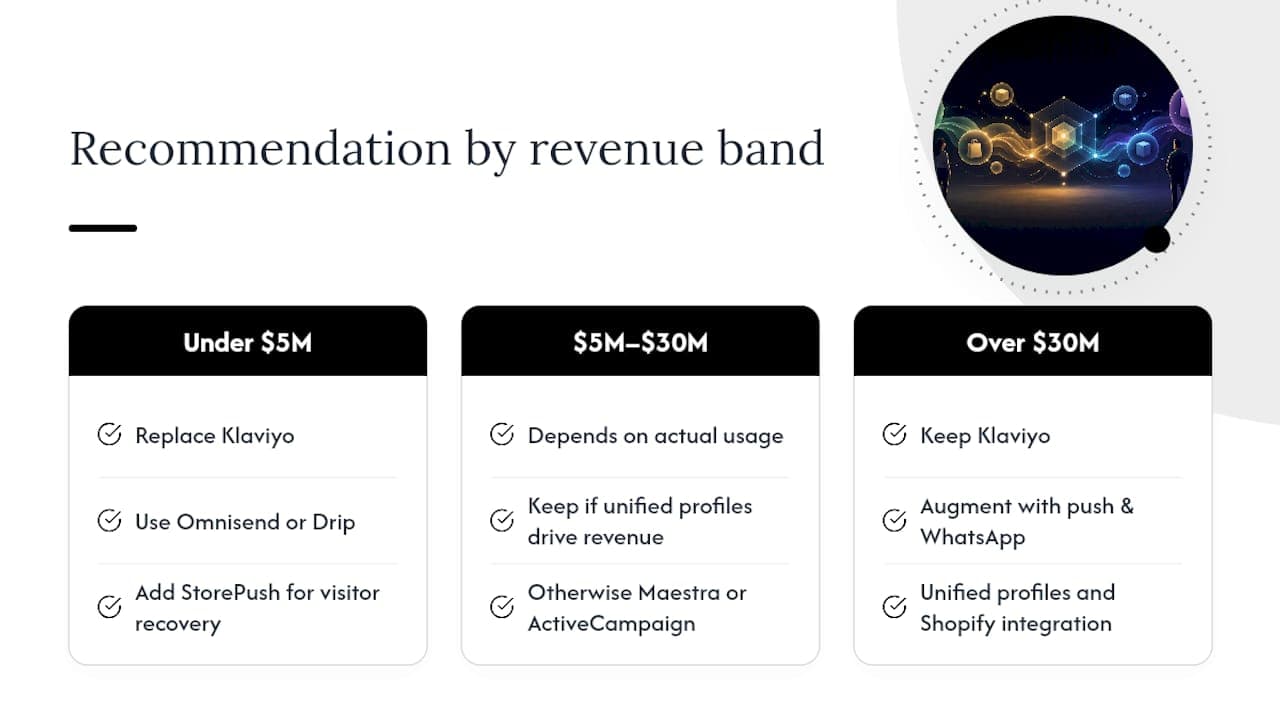
Under $5M: Replace Klaviyo. The pricing overhead and complexity rarely justify themselves at this stage. Omnisend or Drip give you 90% of the automation capability at a fraction of the cost. Add StorePush to recover the visitors your new email platform still can’t reach.
$5M–$30M: It depends on what you’re actually using. If Klaviyo’s unified customer profiles and predictive analytics are driving measurable revenue, keep them and augment with a specialist push tool. If you’re paying for features your team doesn’t use, Maestra or ActiveCampaign give you a more efficient path. Composable stacks are gaining traction at this revenue band precisely because no single platform does everything best.
Over $30M: Klaviyo’s structural advantages for Shopify-native DTC brands are real at this scale. The unified profile and deep Shopify integration are genuinely hard to replicate. The question isn’t whether to replace Klaviyo but whether to augment it with channel-specific tools where it lags, particularly push recovery and WhatsApp.
One practical note on evaluation windows: a 30-day pilot is enough to validate deliverability and basic flow performance. Attribution accuracy, especially for multi-touch programs, needs 60–90 days to stabilize. Don’t make a final platform decision on 30-day revenue numbers alone.
StorePush recovers the revenue your email platform misses
Every email and SMS platform on this list has one thing in common: they only work for visitors who subscribed. StorePush works for everyone else. By sending push notifications via native iOS App Clips directly to shoppers’ lock screens, it re-engages cart abandoners and browse abandoners who never handed over their contact details. No list required. No warm-up period. No conflict with your existing email flows.
The setup connects directly to Shopify, WooCommerce, BigCommerce, and custom storefronts. The dashboard gives you revenue attribution, CTR heatmaps, funnel tracking, and event-based trigger controls so you can see exactly what StorePush recovers, separate from your email and SMS numbers. For stores switching from Klaviyo to a lower-cost platform, StorePush often recovers enough additional revenue to make the transition cost-neutral from the first month.
If push-first recovery looks like the gap in your current stack, book a StorePush demo and see the numbers for your store specifically. Or explore the StorePush platform to see how it fits alongside your existing email and SMS setup.
Authoritative sources and further reading
The claims and comparisons in this article draw on the following sources. Vendor prices change frequently; verify current pricing directly with each vendor before making a decision.
-
Klaviyo in 2026: The Email-SMS Giant’s Strengths, Gaps, and Growing Rivals – Ecommerce Times
-
Top Klaviyo Alternatives & Competitors 2026 | Gartner Peer Insights
-
7 Best Klaviyo Alternatives for eCommerce (2026) — Venture Harbour
-
16 Klaviyo Alternatives for eCommerce Brands (2026 Picks) | Campaign Monitor
Run a 30-day pilot on your top pick, track recovered revenue against platform cost, and revisit attribution at the 60-day mark before making a final call. If your store has meaningful mobile traffic and a cart abandonment problem, that pilot should include StorePush alongside whichever email platform you choose.