You can recover abandoned carts without collecting emails or phone numbers by using privacy-first push notifications that link shoppers back to a pre-populated checkout. No PII required. No email capture forms. Just a well-timed nudge that lands directly on a shopper’s lock screen while their intent is still warm.
Here’s the shortest path to your first recovery:
-
Instrument your cart events: fire
cart_updated,checkout_started,payment_failed, andpurchase_completedfrom your storefront. -
Enable a two-step push opt-in triggered after a shopper adds an item to their cart, not on page load.
-
Wire a cart-abandoned event to a push payload containing a deep link to a pre-populated checkout, with a collapse key scoped to that cart.
-
Set your first-touch window at 15–60 minutes after inactivity.
-
Suppress on purchase: cancel all scheduled pushes the moment
purchase_completedfires.
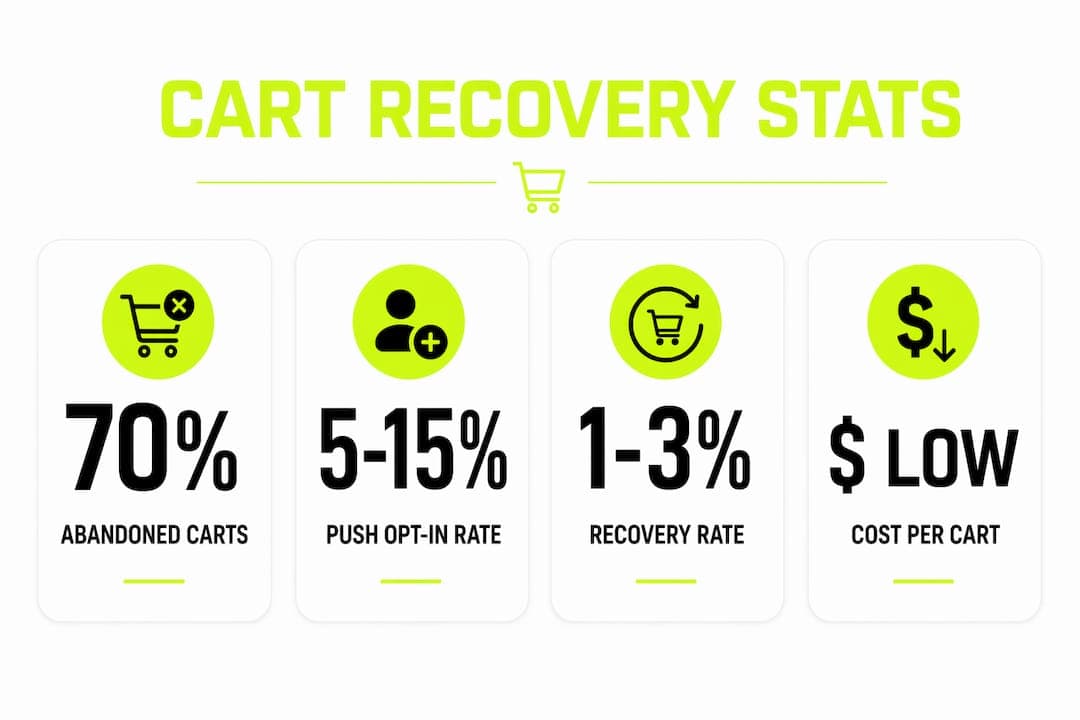
According to the Baymard Institute, 70–72% of e-commerce carts are abandoned before checkout completes; for a store doing $2M in annual revenue, a significant amount of potential merchandise value is lost. Push won’t recover all of it, but even a modest lift on a channel that requires zero PII is worth the setup time.
Table of Contents
Why privacy-first push can recover abandoned carts
Purchase intent decays fast. A shopper who added a jacket to their cart twenty minutes ago is far more likely to complete the purchase than one who did it three days ago. Push notifications hit that window before intent fades, and they do it without requiring an email address or phone number.
The behavioral case: a push notification appears on the lock screen, requires one tap to return to a pre-populated checkout, and feels like a helpful reminder rather than a marketing blast. That low-friction path back is what separates push from email, which gets buried in a Gmail tab and read hours later, if at all.
Email and SMS both require PII to function. Push, when implemented correctly, operates on an anonymous device token. That means no CCPA data-collection obligations tied to contact information, no list hygiene costs, and no deliverability issues. The trade-off is reach: browser push opt-in rates typically sit between 5–15%, so push is a supplemental channel, not a replacement for email. Think of it as a low-cost layer that catches the shoppers your email flow never sees.
Which push approaches work without collecting PII?
Three architectures let you send cart recovery push notifications without touching emails or phone numbers:
-
Browser web push (desktop + Android): works across Chrome, Firefox, and Edge; supported on Android mobile. Shoppers opt in via a browser permission prompt. No PII stored, just an anonymous endpoint token.
-
Native iOS App Clips: Apple’s App Clip framework lets a lightweight version of your store load without a full app install. Storepush uses this approach to reach iOS shoppers who would otherwise be invisible to web push, since iOS web push has significant limitations that cap reach on Safari.
-
Progressive on-site opt-in flows: a two-step prompt (a custom modal first, then the browser permission dialog) shown after a meaningful signal like an add-to-cart event. This avoids the cold-ask rejection that tanks opt-in rates.
Realistic expectations matter here. Opt-in rates of 5–15% mean you’re reaching a fraction of abandoners, not all of them. Android-heavy stores and repeat-visitor audiences tend to see the best results. iOS reach depends heavily on whether you’re using App Clips or relying solely on web push.
Pro Tip: Show a custom modal that explains the value (“We’ll remind you if you leave anything behind”) before triggering the browser permission prompt. This two-step approach can raise subscription rates significantly compared to a cold permission ask on page load.
Exactly when to send and who to target
Not every session deserves a push. Firing on a shopper who spent 10 seconds on a product page is how you train people to block your notifications.
High-intent triggers worth targeting:
-
add_to_cartfollowed by 15–60 minutes of inactivity -
checkout_startedwithout a subsequentpayment_completed -
payment_failedevents (high urgency, high intent) -
Return-visitor persistent-cart sessions where the cart was saved from a prior visit
Segmentation rules:
-
Require at minimum an
add_to_cartevent before scheduling any push. Browsing signals alone don’t qualify as high-intent abandonment. -
Exclude sessions where cart value is $0 or items were removed before inactivity.
Cadence:
-
Touch 1: 15–60 minutes after cart inactivity. No discount. Urgency or social proof only.
-
Touch 2 (optional): 3–6 hours later for high-AOV carts, or 24 hours for lower-urgency verticals. Cap at two touches per cart.
Suppression checklist:
-
Cancel all scheduled pushes on
purchase_completed. -
Cancel on
cart_cleared. -
Cancel if the shopper resumes and completes checkout on a different device (match on
anonymousIdor session token).
What to say: copy tactics and sample templates
The single biggest mistake in push copy is leading with a discount. Offering an incentive on the first touch trains shoppers to abandon intentionally, knowing a coupon is coming. It also erodes margin on customers who would have converted anyway.
Copy rules:
-
Touch 1: urgency or social proof, no discount, single CTA to deep-linked checkout.
-
Touch 2: introduce social proof, low-stock signal, or a modest incentive only if touch 1 didn’t convert.
-
Keep body copy short enough to fit under the ~4 KB payload limit. Product details load on the landing page, not in the notification.
Sample templates:
Touch 1 — Reminder: “Your [Product Name] is still in your cart. Grab it before it sells out.”
Touch 1 — Social proof: “47 people are looking at [Product Name] right now. Your cart is saved.”
Touch 2 — Low stock: “Only 3 left in stock. Your cart expires soon.”
Touch 2 — Incentive: “Here’s 10% off to complete your order. Expires in 24 hours.”
Safe personalization tokens that don’t require PII: product title, cart value band (e.g., “your $85 cart”), and inventory status. Rotate angles across A/B sets so the channel doesn’t feel templated and opt-out rates stay low.
Technical setup checklist
Instrument your events
-
Fire
cart_updatedwithcartId,anonymousId,items[],cartValue,currency, and aconsentGrantedflag. -
Fire
checkout_startedandpayment_failedwith the same schema. -
Fire
purchase_completedimmediately on order confirmation to trigger suppression.
Design your payload
-
Keep push ciphertext under 4 KB. Put cart contents behind the deep link, not in the notification body.
-
Include a collapse key scoped to
cartIdso newer pushes replace older ones instead of stacking. -
Set TTL to 1–4 hours. A stale push arriving six hours later, after the shopper already bought elsewhere, is a trust-damaging experience.
-
Use
aes128gcmencryption for web-push payloads.
Suppression and error handling
-
Cancel scheduled pushes immediately on
purchase_completedorcart_cleared. -
Handle 410 (endpoint gone) by deleting the subscription; handle 429/5xx with exponential backoff.
Platform integrations
-
Shopify: use Shopify’s native checkout events via webhooks or the Storefront API; a lightweight Cloudflare Worker or small Node service fans out events to your push delivery layer.
-
WooCommerce: hook into
woocommerce_add_to_cartandwoocommerce_checkout_order_processedactions. -
BigCommerce: use the BigCommerce Webhooks API for
store/cart/abandonedandstore/order/statusUpdatedevents.
For Shopify-specific persistent cart patterns, saving cart state server-side before the push sequence fires can meaningfully lift recovery rates for returning visitors.
KPIs, attribution, and A/B tests to run
Measure what actually matters, not what’s easy to count.
Primary KPIs:
-
Incremental recovered revenue vs. a holdout group (the only number that proves true lift)
-
Conversion rate on attributed deep-link checkouts (track via
?src=pushparameter) -
Opt-out/disable rate per send
-
Recovered revenue per 1,000 abandoners
| KPI | How to compute | Target |
|---|---|---|
| Incremental recovery rate | (Push group purchase rate) minus (holdout group purchase rate) | Positive vs. holdout |
| Deep-link conversion rate | Completed purchases / push clicks with src=push | Benchmark against email CTR |
| Opt-out rate | Unsubscribes / sends per campaign | Keep below 3% |
| Revenue per 1,000 abandoners | Total push-attributed revenue / (abandoners / 1,000) | Varies by AOV |
Attribution pitfall: a click is not a recovery. Only count a purchase_completed event that fires within your attribution window (typically 7 days) after a push click with a src=push parameter. Without this, you’ll double-count shoppers who would have returned organically.
Experiments to run:
-
Holdout group of 10–15% suppressed for 30 days to measure true incrementality.
-
A/B test touch 1 timing: 15 minutes vs. 60 minutes.
-
A/B test incentive placement: touch 1 vs. touch 2 only.
US privacy and platform rules to check first
Push can be privacy-safe when you keep PII out of payloads and maintain a clean consent log. For U.S. businesses, CCPA applies when you collect personal information from California residents. An anonymous device token tied to no name, email, or phone number sits in a much lower-risk category, but you still need to honor opt-out requests and maintain records of consent.
Operational checklist:
-
Keep an append-only
consent_logwith a timestamp for every opt-in action. -
Never store customer emails, phone numbers, or names in push payloads or notification metadata.
-
Be able to prove opt-in for any push endpoint you message.
-
Honor unsubscribe/block events immediately and purge the endpoint.
Platform guardrails:
-
iOS App Clips operate under Apple’s App Clip guidelines, which restrict certain data collection and require the experience to be lightweight and task-focused.
-
Web push on iOS Safari requires iOS 16.4+ and a home-screen PWA install, which limits reach significantly. Plan for this gap with fallback channels.
The practical rule: if your push payload contains anything that could identify a specific person, you’ve crossed into PII territory and your privacy posture changes. Keep payloads to product title, cart value band, and a deep link. That’s it.
Pro Tip: Set quiet hours (typically 9 PM–8 AM local time) and a frequency cap of two pushes per cart. High complaint rates and notification blocks are harder to recover from than a missed conversion.
Common errors that kill push-based cart recovery
-
Firing too fast: sending a push within seconds of cart add feels like surveillance. Wait at least 15 minutes.
-
Leading with a discount in touch 1: trains repeat abandonment and erodes margin on customers who didn’t need the incentive.
-
Embedding prices or product images in the payload: bloats the notification, risks stale data, and often exceeds the 4 KB limit.
-
Failing to suppress after purchase: texting a buyer about a cart they’ve already checked out destroys trust fast.
-
Skipping collapse keys: without a cart-scoped collapse key, a shopper who returns and re-abandons gets stacked notifications from both sessions.
-
Long TTLs: a push that arrives eight hours later, after the shopper bought from a competitor, is worse than no push at all.
A short note on iOS reach: web push on iOS is still limited. If a meaningful portion of your traffic is iPhone users who haven’t installed your PWA, you need a fallback. Email, SMS, or Storepush’s native iOS App Clip approach fills that gap.
Quick wins and realistic ROI expectations
Start with three experiments before building anything complex.
Experiment 1: Enable a two-step push opt-in modal triggered on add_to_cart. Measure opt-in rate over 14 days.
Experiment 2: Send a single 15–60 minute deep-link reminder to opted-in abandoners. No discount. Track src=push conversions.
Experiment 3: Suppress 10–15% of abandoners as a holdout. After 30 days, compare purchase rates to prove incrementality.
Push typically recovers 1–3% of abandoners, with a cost per recovered cart that’s often low. For a store with 1,000 monthly abandoners and an average order value of $90, recovering 1–3% means 10–30 additional orders per month from a channel that required no email capture. Stores with Android-heavy audiences and high repeat-visitor rates tend to see the best early results. Scale the program only when opt-out rates stay below 3% and your holdout test shows positive incremental lift.
Storepush makes privacy-first push recovery practical
Most push tools require you to collect emails or phone numbers before they’ll work. Storepush is built differently. It uses browser push combined with native iOS App Clips to reach shoppers on their lock screens without touching PII, which means you can start recovering carts on day one, even for the 90%+ of visitors who never hand over their contact details.
Storepush integrates directly with Shopify, WooCommerce, BigCommerce, and custom storefronts. It handles payload design (under 4 KB, deep-linked to a pre-populated checkout), suppression logic (cancels sequences the moment a purchase fires), and attribution through a dashboard that tracks recovered revenue, CTR heatmaps, and funnel events. You get the full technical stack described in this article without building it yourself.
Ready to see it in action? Book a demo or explore the Storepush platform to check integrations and pricing.
Key takeaways
Privacy-first push notifications let you recover abandoned carts without collecting emails or phone numbers by combining browser push, iOS App Clips, and precise suppression logic tied to purchase events.
| Point | Details |
|---|---|
| Abandonment benchmark | 70–72% of carts are abandoned; even recovering 1–3% of abandoners adds meaningful revenue. |
| Two-step opt-in first | Trigger the push permission prompt after add_to_cart, not on page load, to improve subscription rates. |
| No discount in touch 1 | Lead with urgency or social proof; reserve incentives for touch 2 to protect margins. |
| Suppress on purchase | Cancel all scheduled pushes immediately when purchase_completed fires to avoid trust-damaging follow-ups. |
| Storepush | Uses browser push and native iOS App Clips to recover carts without PII; integrates with Shopify, WooCommerce, and BigCommerce. |
Why privacy-first push is the right bet for most merchants
The conventional wisdom on cart recovery is to layer every channel simultaneously: email, SMS, retargeting, push. That’s sound advice for a well-resourced team with clean data. But most merchants don’t have clean email lists, and SMS costs add up fast when opt-out rates climb.
Privacy-first push occupies a different position. It reaches shoppers you’d otherwise lose entirely, costs almost nothing per send, and doesn’t require you to build a data collection infrastructure before you can start. The channel’s reach ceiling is real, and you shouldn’t pretend push alone replaces a full multi-channel stack. But as a low-friction first layer that protects margins and sidesteps PII obligations, it earns its place in almost every recovery program.
The merchants who get the most from it treat push as a complement to on-site persistence and email, not a substitute. Get persistent carts working first, then add push for the anonymous visitors your email flow can’t reach. That sequencing, combined with a clean holdout test, is how you build a recovery program you can actually trust the numbers on.
Useful sources
-
Baymard Institute cart abandonment benchmark via Ecommerce Times
-
Web push cart recovery playbook for Shopify (Growth Suite)
-
Cart abandonment push notification technical playbook (web-push-notifications.com)
-
Holdout measurement and incrementality guide (D2C Times)
-
Cart abandonment recovery multi-channel playbook (72 Technologies)
-
Push notifications for abandoned cart recovery (PushPilot)