
The highest-performing winback approach for ecommerce is a phased, segmented sequence that starts at roughly twice your product's repurchase cycle and layers SMS or push onto email for your highest-value lapsed shoppers. Done well, this typically reactivates 10 to 20% of lapsed customers. Your next move: tag lapsed customers by recency, frequency, and monetary value, then launch a three-to-five message automated sequence this week.
TL;DR:
- Segment lapsed customers by recency, frequency, and monetary value to tailor messaging and prioritize high-value segments for higher reactivation rates.
- Trigger the first winback message around twice the product's average repurchase cycle and escalate offers only after soft touches fail.
- Combine email, SMS, push notifications, and retargeting in a coordinated, multi-channel approach to improve reactivation by up to 50 percent.
- Use tiered discounts of 10 to 15 percent initially, reserving higher offers or exclusive perks for VIP segments or final touch points.
- Implement strict sunset and suppression rules, and customize messages based on specific lapse reasons to maximize deliverability and conversion.
Table of Contents
- What Are Winback Campaigns in Ecommerce?
- Why Winbacks Belong In Your Growth Stack
- The Core Components Of A Winback Program
- When Should You Start A Winback Sequence?
- Five Winback Sequence Templates You Can Copy Today
- How Big Should Your Winback Discount Be?
- How Should Email, SMS, Push, And Retargeting Work Together?
- What Metrics Actually Prove A Winback Program Works?
- Common Winback Mistakes And A Fast Audit
- Where Does Push Notification Recovery Fit In A Winback Playbook?
- Why Do Customers Actually Lapse?
- How Do You Personalize A Winback Beyond Basic Segments?
- What Legal Rules Apply To Winback Emails And Texts?
- What I'd Tell Any Team Building A Winback Program
- StorePush: A Complementary Layer For Mobile-First Winback Recovery
- Where To Go Deeper On Winback Strategy
- Sources
What Are Winback Campaigns in Ecommerce?
A winback campaign is a scheduled sequence of emails, texts, or push notifications aimed at customers who used to buy from you and stopped. That's different from abandoned cart recovery, which chases someone who bailed mid-checkout within hours. Winbacks operate on a much longer clock, often triggered weeks or months after a customer's last purchase, and they're solving a different problem: not "you forgot to check out" but "you forgot we exist." The distinction matters for KPIs and creative strategy alike. A cart recovery email can lean on urgency ("your items are waiting"). A winback message has to work harder, often needing to remind the shopper why they liked you in the first place before it can ask for anything.
The job of a winback sequence isn't just to generate one more sale. It's to figure out, at scale, why someone left, and to close that gap before you spend real money re-earning their trust.
Why Winbacks Belong In Your Growth Stack
Reactivating a lapsed customer typically costs between $5 and $15, compared to $30 to $100 to acquire someone new in many categories. That gap alone should move winback programs higher on your roadmap, especially when acquisition costs keep climbing and every marketer is fighting for the same paid social inventory.
The math that changes budget conversations: if new customer acquisition runs you $60 and reactivation runs you $10, a winback program that recovers just 500 lapsed customers a month can free up tens of thousands of dollars a year that would otherwise go to ad platforms.
Reactivated customers also tend to spend differently than first-time buyers. They already know your sizing, your shipping speed, your return policy. That familiarity often translates into a faster path to repeat purchase and, over time, a higher customer lifetime value than a cold acquisition, because you're not paying to teach them who you are twice.
So when should winbacks outrank acquisition testing for your next sprint? If your churned customer list has grown past a few thousand contacts and you haven't touched it in 90 days, you're sitting on inventory that's cheaper to reactivate than almost anything your paid media team can deliver. Acquisition tests still matter for growth, but a stagnant winback list is the closest thing ecommerce has to free money left on the table.
The Core Components Of A Winback Program
Every functioning winback program, regardless of what you sell, needs the same five moving parts. Skip one and the whole system underperforms, usually in ways that are hard to diagnose after the fact.
- Segmentation and triggers: rules that decide who counts as "lapsed" and when a sequence fires, based on repurchase cycle and customer value.
- Sequence architecture: the number, order, and spacing of messages, each with a distinct job rather than a repeat of the same pitch.
- Offer policy: a documented set of rules for what discount or incentive escalates at which stage, so no two team members improvise different numbers.
- Channel mix: which messages go by email, which earn an SMS or push slot, and which get reinforced with retargeting ads.
- KPIs and sunset rules: the metrics that tell you the program is working, plus the rule that removes unresponsive contacts before they hurt deliverability.
Each message in a sequence has one job, not three. The first touch should simply remind the customer you exist, often with a soft, no-discount nudge. The second introduces value, maybe new arrivals or a bestseller they haven't seen. Only the third or fourth message should carry a real offer, and the final message should function as a genuine last call, not another "just checking in."
That kind of restraint pays off in deliverability. Inboxes weigh engagement history heavily. A sequence that blasts unresponsive contacts forever tanks your sender reputation and drags down performance for every other campaign you run, including the abandoned cart flow you already rely on. Building a suppression rule from day one protects the rest of your email program, not just the winback flow itself. Segmenting by why someone lapsed, rather than sending one blast to everyone, also meaningfully outperforms a one-size-fits-all approach, which is exactly what the next section walks through.
When Should You Start A Winback Sequence?
A dependable rule of thumb is to trigger the first winback touch at roughly twice your product's average repurchase cycle. If customers typically reorder your product every 30 days, don't wait until day 90 to say something. Start at day 60, while the relationship is still warm enough to revive with a light nudge instead of a full-blown offer.
Not every lapsed customer deserves the same urgency. This is where RFM segmentation, recency, frequency, and monetary value, earns its keep. A customer who bought five times in the last year and lapsed 60 days ago is a very different priority than someone who bought once, eighteen months ago, and never opened another email. Treat your top RFM tier as VIP candidates: skip the soft nudge and go straight to a personalized message, sometimes even a real outreach from a support or loyalty team member rather than an automated blast.
Three categories need special handling. Subscriptions that lapsed through a failed payment or a pause aren't really "lost" customers; they need a restart-focused sequence, not a discount-first one. Replenishment goods (razors, filters, pet food) respond well to simple, low-drama reminder messaging, since the customer's need hasn't changed, only their memory of ordering has. Long-cycle purchases like mattresses or furniture rarely warrant a winback at all inside 12 months. Send a light brand-presence touch instead, and save the real sequence for when a repurchase is plausible.
Five Winback Sequence Templates You Can Copy Today
These templates are built to be filled in with your own product names, discount policy, and brand voice. Each escalates in a specific order for a reason: soft touches first, offers only once a soft touch has failed to work.
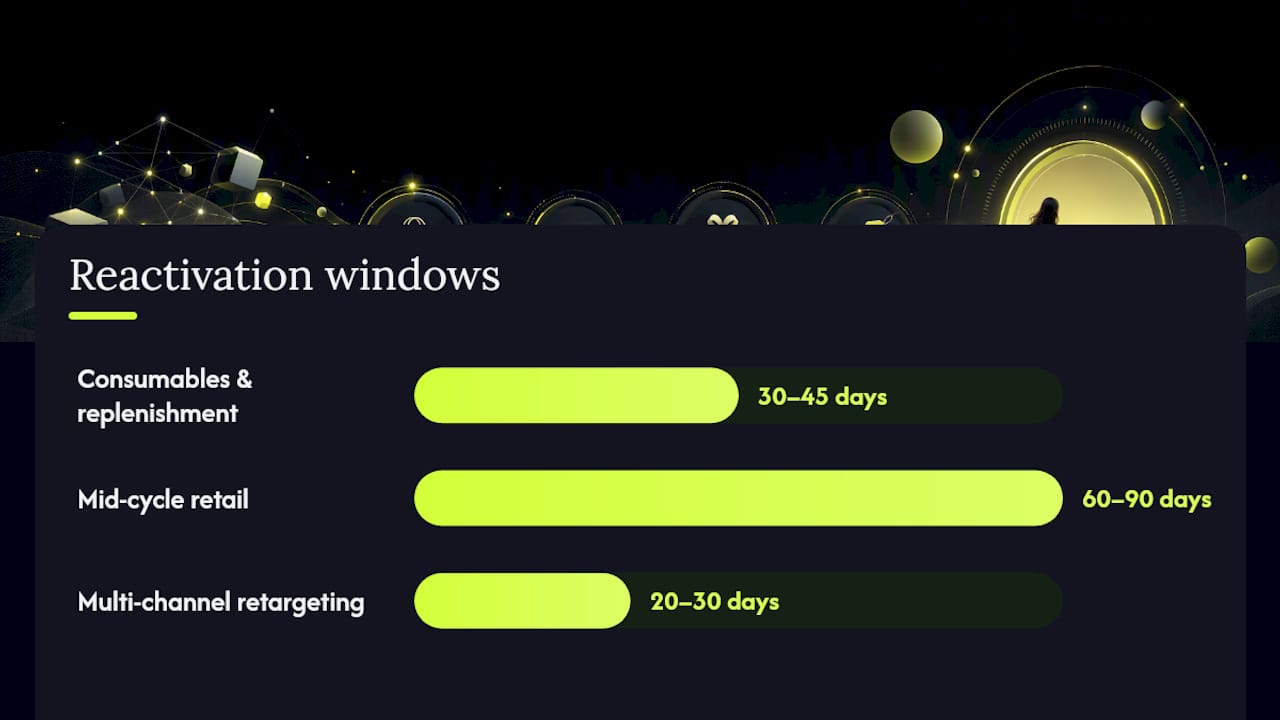
1. Consumables and replenishment template (3 to 5 emails over 30 to 45 days)
- Day 0: "Running low on [product]?" — a pure reminder, no discount, framed around the customer's likely need.
- Day 7: Educational or usage tip email, reinforcing why the product works, with a subtle reorder link.
- Day 14: First offer, typically 10 to 15% off or free shipping on the next order.
- Day 30: Escalated offer for anyone who hasn't converted, often a bundle deal instead of a straight discount.
- Day 45: Final "last chance" message before moving the contact to a lower-frequency nurture list.
Sample subject lines worth testing: "Did you run out of [product]?", "It's probably time to restock", and a more direct "10% off your next order, just because."
2. Mid-cycle retail template (60 to 90 day window)
This one leans on merchandising, not just discounting. Pull in dynamic product recommendations based on the customer's past purchase category, and insert a review or user-generated content block around message two or three. Social proof does real work here: showing a shopper that other people just like them are still buying reactivates interest without needing a markdown at all.
3. VIP and high-LTV template
Skip the automated soft nudge. Open with a message that acknowledges their history directly, "We noticed you haven't ordered in a while, and we wanted to check in personally", paired with a VIP-only incentive like early access to a new collection or a higher-value loyalty credit. For your top decile of customers, a real human touch (a personal note from a founder or account manager) often outperforms anything templated.
4. Subscription restart template
Offer flexible frequency options up front, since a lapsed subscriber often churned over cadence, not the product itself. "Too much? Switch to every 60 days instead of every 30" solves a real objection. Pair that with a limited-time restart incentive, free shipping on the resumed order or a bonus item, rather than a blanket percentage discount that trains people to expect one every time they pause.
5. Multi-channel hybrid template
Layer SMS in at the offer stage, not the first touch, reserved for high-value segments who've opted in. Add push notifications for mobile-first shoppers who rarely open email but browse on their phone. Bring in retargeting ads around day 20 to 30 as reinforcement, using the same creative and offer language as the email sequence so the message feels consistent across channels rather than like three different companies talking at once.
How Big Should Your Winback Discount Be?
Start smaller than you think you need to. A 10 to 15% opening offer performs well across most categories, and discounts above roughly 20% rarely produce proportionate lift once you account for the margin you're giving away. Escalate only for segments that have earned it, high-value RFM tiers or customers who ignored your first two messages entirely.
- Start at 10 to 15% off for the first offer touch in any sequence.
- Reserve 20% or higher for VIP segments or the final "last chance" message only.
- Use free shipping as a lower-cost first offer, especially for categories where shipping cost is a known objection.
- Offer loyalty points or exchange credit instead of cash discounts to protect margin while still feeling like a reward.
- Try early access to new drops or restocks as a non-discount incentive for fashion and limited-inventory brands.
Tiered discounts tend to lift recovered average order value better than a flat percentage. Structure it like "10% off any order, 15% off orders over $75, 20% off orders over $150" and you're rewarding bigger baskets instead of just subsidizing whatever the customer was already going to buy.
Pro Tip: Before you escalate a discount, ask whether a bundle or gift-with-purchase would recover the same sale without setting a price anchor you'll regret next quarter. Once a customer expects 20% off to come back, they'll wait for it every time.
How Should Email, SMS, Push, And Retargeting Work Together?
Email should remain the backbone of any winback program. It's the lowest-cost channel, it supports the richest creative, and it's where most of your sequence logic already lives. But combining email with SMS or push meaningfully outperforms email alone, particularly for segments who've already shown they don't engage with your inbox.
- Email: focus on deliverability first, warm up sending domains, keep subject lines specific rather than clickbait, and give each message in the sequence one clear creative job.
- SMS: reserve it for urgent, high-value offers and customers who've explicitly opted in; overusing SMS for low-stakes reminders burns trust fast.
- Push and App Clip messaging: useful for mobile-first shoppers, especially ones who rarely open marketing email but browse frequently on a phone.
- Retargeting ads: keep creative and offer language consistent with your email sequence so the same shopper sees one coherent message across every touchpoint.
SMS and push typically ride on top of that split rather than claiming a fixed percentage, since they're triggered selectively rather than blasted to the full list.
Multi-channel sequences that combine email with SMS or push produce roughly 30 to 50% higher reactivation than email-only flows for the segments where those channels are used deliberately, not blanketed across every lapsed contact.
What Metrics Actually Prove A Winback Program Works?
Reactivation rate (the percentage of targeted lapsed customers who purchase again) is your headline number, but it's not the only one that matters. Revenue recovered and revenue per email tell you whether the program is profitable, not just active. ROI ties the whole thing together against what you spent on discounts and channel costs. Post-reactivation retention is the metric most teams skip and shouldn't: a reactivated customer who churns again in 30 days isn't a win, it's a delay.
- Track reactivation rate by segment, not just in aggregate, since a blended number hides which cohorts are actually responding.
- Calculate revenue per email or per SMS sent to compare channel efficiency directly.
- Measure ROI against total sequence cost, including any discount value given away, not just platform fees.
- Watch post-reactivation retention for 60 to 90 days to confirm the win wasn't a one-time discount grab.
- Use incrementality testing (a holdout group that receives no winback touch) when you need to prove the sequence caused the sale rather than just coinciding with it.
For A/B testing, change one variable at a time: subject line first, then offer structure, then timing. Testing multiple variables at once makes it nearly impossible to know which lever actually moved the number. And build a sunset rule from the start, moving contacts to long-term suppression after they've ignored a full sequence, so your sender reputation stays intact for every campaign that follows.
Common Winback Mistakes And A Fast Audit
A generic "we miss you" blast is the single most common failure mode, mostly because it treats every lapse reason the same. A customer who left because of a shipping delay needs a different message than one who simply ran out of need for your product. Diagnosing the actual lapse reason, through post-purchase surveys, support ticket history, or simple RFM patterns, lets you match the recovery message to the real problem instead of guessing.
The second big mistake is skipping sunset and suppression rules entirely, which quietly damages deliverability for every campaign you send, not just the winback flow. The third is training customers to wait for a discount by leading every sequence with one; once shoppers learn that ignoring your emails eventually earns them 20% off, they'll ignore them on purpose.
Run this ten-point check against your current flow:
- Do you segment lapsed customers by lapse reason, not just recency?
- Does your first message avoid leading with a discount?
- Is your sequence timed to roughly 2x the category's repurchase cycle?
- Do you have a documented offer escalation policy?
- Are SMS and push reserved for opted-in, high-value segments only?
- Is there a sunset rule that suppresses unresponsive contacts?
- Do you track revenue per message, not just open rate?
- Have you tested subject lines and offers separately, not simultaneously?
- Do you measure post-reactivation retention, not just the first repeat sale?
- Is your VIP segment getting a distinct, less automated experience?
Pro Tip: If you can't answer "yes" to at least seven of these, pause new acquisition spend for a week and fix your winback flow first. It's usually the faster win.
Where Does Push Notification Recovery Fit In A Winback Playbook?
Push and App Clip based recovery earns its place in a winback stack when email and SMS simply can't reach someone. Mobile-first shoppers who browse on their phone, never opted into SMS, and let marketing emails pile up unread are a real, sizable slice of most ecommerce audiences, and they're effectively invisible to a traditional sequence.
- Add push as a supplementary touch for segments with high mobile traffic and low email open rates.
- Prioritize high-LTV lapsed customers who haven't opened any email in the sequence, since they're the ones most worth a second channel.
- Place push notifications around the middle of your sequence, after the soft reminder but before the final offer, so it reinforces rather than repeats.
- Use it for shoppers who never handed over an email or phone number in the first place, since App Clip based push doesn't require that data upfront.
This isn't a replacement for email. It's a way to reach the portion of your lapsed list that email was never going to touch anyway.
Why Do Customers Actually Lapse?
Most churn isn't dramatic. Customers rarely leave because they hate your brand; they leave because life got in the way, a competitor's ad caught them at the right moment, or your product simply didn't need reordering as often as your sequence assumed. Understanding the real reason behind a lapse changes everything about how you write the recovery message.
Four patterns show up again and again. First, satisfaction drift: the customer liked the product fine but never formed a habit around it, so reordering just slipped their mind. Second, friction memory: a slow shipment, a clunky return process, or a bad support interaction left a lingering hesitation, even if they never complained. Third, price sensitivity that shifted: a customer who bought happily at full price six months ago might now be more budget-conscious, and a straight reminder won't move them without some kind of value signal. Fourth, genuine need change: they stopped needing the product at all, maybe they switched diets, moved, or their kid outgrew what you sell, and no amount of clever copy will win that back.
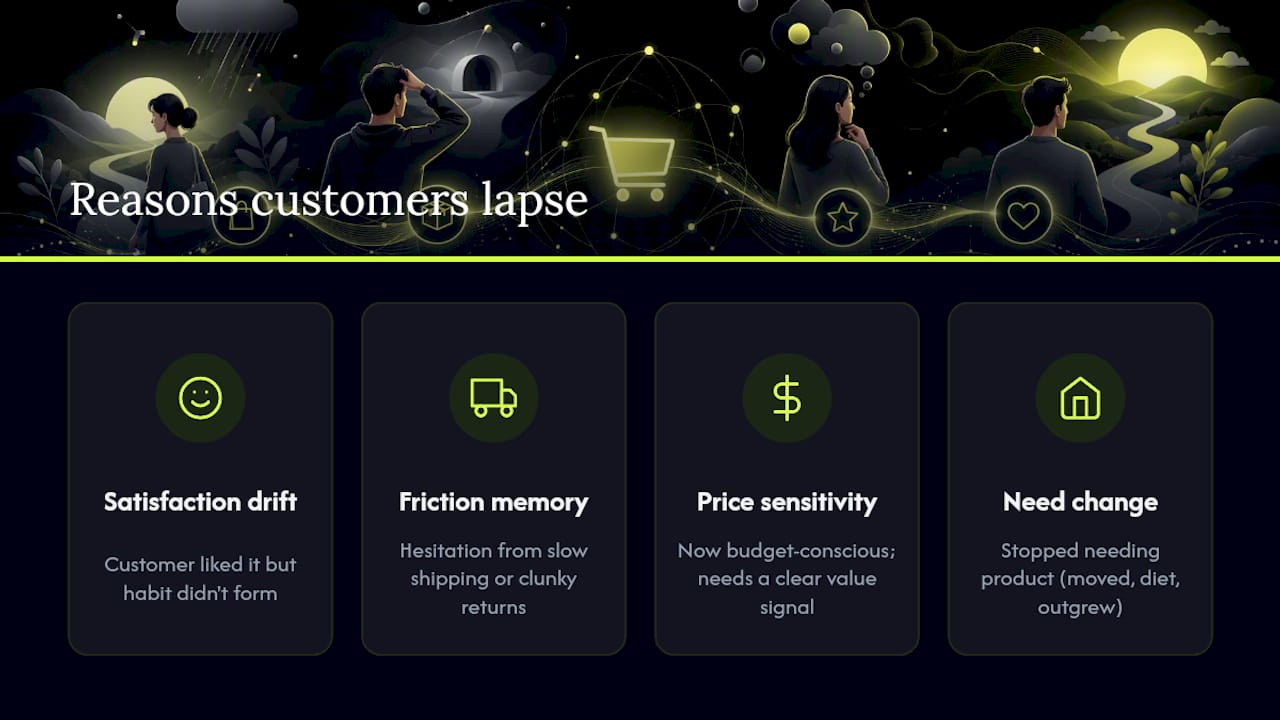
Matching message to reason is where segmentation earns its value. A friction-memory customer needs reassurance ("we've improved our shipping since your last order"), not a discount. A satisfaction-drift customer just needs a nudge and a reminder of why they liked you. Guessing wrong here wastes both the send and, often, a discount you didn't need to offer. Reviewing support tickets and post-purchase survey data before you write sequence copy is worth more than any amount of A/B testing on subject lines alone.
How Do You Personalize A Winback Beyond Basic Segments?
Segmentation gets you to the right audience. Personalization gets you to the right message for that individual, and it's the layer most ecommerce brands skip because it takes more setup work.
Dynamic content is the easiest win: instead of a generic "check out our bestsellers" block, pull in the specific category or even the specific product a customer previously bought, and recommend logical companions or replacements. A customer who bought a specific running shoe should see that shoe's newer version or a matching accessory, not your entire catalog's top sellers.
Behavior-based triggers go a step further. If a lapsed customer visits your site during the sequence but doesn't buy, that's a signal worth acting on immediately, not waiting for the next scheduled touch. A visit to a specific product page mid-sequence can trigger a follow-up message referencing that exact product within hours, closer to how browse abandonment triggers work than a standard drip. Purchase history depth matters too: a five-time repeat customer deserves language that acknowledges loyalty, while a one-time buyer needs a message that re-establishes basic trust in your brand.
The tactic that gets underused is negative signal personalization, adjusting the message when you know something didn't go well. If a customer's last order included a return, don't send generic "we miss you" copy; acknowledge it, however briefly, and offer something that removes the specific friction they hit.
What Legal Rules Apply To Winback Emails And Texts?
Winback messages are still commercial marketing communications, and they're bound by the same rules as any other campaign. In the United States, that means CAN-SPAM compliance: a clear and accurate "from" line, no deceptive subject lines, a visible physical address, and a working unsubscribe link that you honor within 10 business days. None of that changes because the recipient hasn't bought from you in six months.
SMS carries a stricter bar. The Telephone Consumer Protection Act requires prior express written consent before you text a customer, and that consent doesn't automatically carry over from an email opt-in. If a customer only gave you their phone number at checkout without explicit texting consent, adding them to an SMS winback sequence is a compliance risk, not just a courtesy issue.
If any part of your customer base sits in the European Union or the UK, GDPR adds another layer: you need a lawful basis for continuing to email someone who has gone inactive, and "they bought from us once" doesn't hold indefinitely. Many brands build a re-permission step into long-lapsed segments, explicitly asking dormant EU contacts to confirm they still want to hear from you before continuing indefinitely. It's a smaller list afterward, but a cleaner and more compliant one. When in doubt on a specific jurisdiction's rules, treat this as a question for legal counsel rather than a marketing blog, since the penalties for getting it wrong scale with your list size.
What I'd Tell Any Team Building A Winback Program
Three rules hold up across almost every account I've looked at. First, never lead with a discount. The soft nudge does more work than marketers expect, and it costs you nothing. Second, build the sunset rule before you build the sequence, not after your deliverability tanks. Third, treat your VIP segment as a different program entirely, not just a higher discount tier inside the same automated flow.
The biggest surprise for most teams is how much retention data changes after 60 days. A reactivation that looks great in week one but evaporates by week eight usually means the discount did the work, not the relationship.
Run a small test on your highest-value lapsed segment before rolling anything out store-wide, and track post-reactivation retention as closely as the initial win.
— Lucas
StorePush: A Complementary Layer For Mobile-First Winback Recovery
Most winback programs stall at the same wall: the customers who never gave you an email or phone number to begin with, or who gave you one they never check. StorePush closes that gap by reaching shoppers through native iOS App Clips that land directly on the lock screen, no app install, no email capture, no phone number required. For the mobile-first, app-averse portion of your lapsed traffic that a traditional sequence may not reach, it offers an additional channel rather than a workaround.
It plugs into common ecommerce platforms and provides dashboard analytics for revenue attribution and CTR tracking so you can monitor which push touches are pulling lapsed shoppers back. Slot it in as a supplementary touch alongside your existing email sequence rather than a replacement for it.
If you're curious what that looks like against your own traffic, book a demo or take a look at the full feature set to see where it fits your current winback flow.
Where To Go Deeper On Winback Strategy
For the reactivation and cost benchmarks referenced throughout this guide, Rework's win-back campaign resource is a solid starting point. For category-specific timing rules and repurchase cycle math, see US Tech Automations' breakdown. Klaviyo's winback email examples are useful for channel-mix benchmarks, and Retently's DTC winback guide covers lapse-reason segmentation in more depth. For broader retention tactics beyond winbacks specifically, Baby Love Growth's retention strategies round out the lifecycle picture.
Sources
- Win-Back Campaigns: Reactivating Lapsed Customers
- E-Commerce Win-Back Campaigns: Reactivate 15% of Lapsed (2026)
- DTC Winback Emails: How to Re-activate Lapsed Customers